You are writing a service report, a rental notice, a job listing, or a website page, and you stop mid-sentence. Does the word end in -tenance or -tainance? The word sits in front of you and looks slightly wrong whichever way you type it.
That hesitation is common. The word turns up in contracts, invoices, engineering manuals, school notices, and everyday conversation, yet it trips up native and non-native English speakers alike. The cause is a small quirk in how English builds nouns from verbs, and once you see it, the spelling stops being a coin toss.
This guide settles the question, explains why the wrong version feels so natural, traces the word back to its roots, and gives you practical ways to remember the correct form. It also shows how the word behaves in different fields, from household repairs to software and family law.
The Short Answer: Maintenance Is Correct
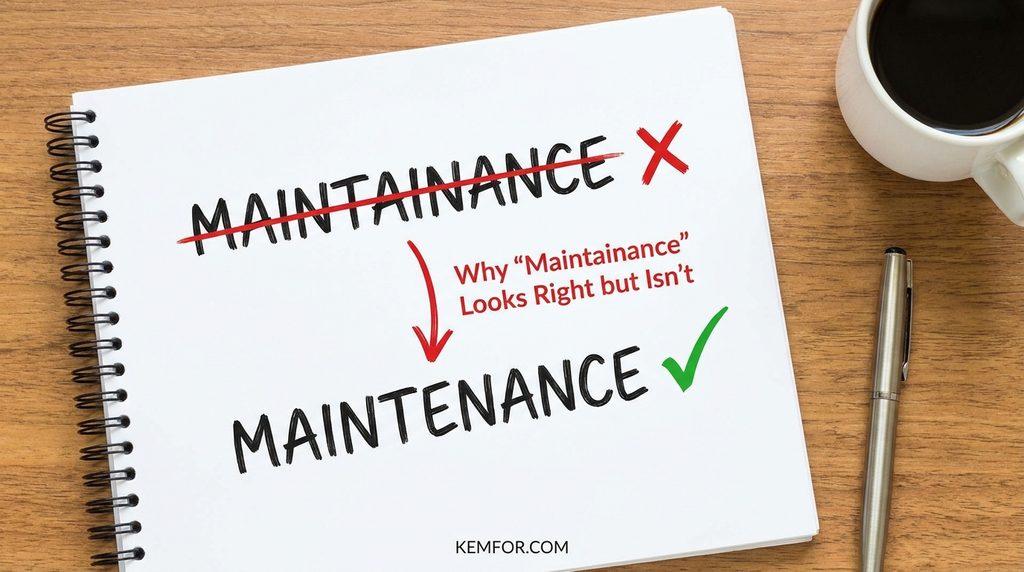
The correct spelling is maintenance. The form maintainance is not a variant, a regional alternative, or an older style. It is a misspelling, and no major English dictionary lists it as acceptable in American, British, Canadian, or Australian usage.
Here is the shape of the word:
- Correct: main-ten-ance
- Incorrect: main-tain-ance
The verb is spelled maintain, with “ai” in the middle. The noun drops that “ai” and uses “e” instead. That single swap is the whole difficulty.
Why “Maintainance” Looks Right but Isn’t
Misspellings rarely appear at random. They usually have a logic behind them, and the logic here is easy to understand.
The Pull of the Verb “Maintain”
Most English nouns ending in -ance or -ence are formed by attaching a suffix to a verb. When the verb is short and stable, the spelling carries over: perform becomes performance, guide becomes guidance, resist becomes resistance. Your brain learns that pattern and applies it to everything.
So when you want the noun for the act of maintaining something, your mind reaches for the verb “maintain,” attaches “-ance,” and produces maintainance. It feels like the system is working. In this case the system has an exception.
How Pronunciation Fuels the Error
Spoken English adds to the confusion. In most accents, the second syllable of maintenance is unstressed and reduced. It sounds like a soft “tn” or “tuhn,” close to the sound in mountain or fountain. Because the vowel is so weak, your ear gives you little information about whether the letter behind it is “a” or “e.”
Compare the verb, where the second syllable carries real stress: main-TAIN. You hear a clear long “a” sound there. In the noun, the stress shifts to the first syllable (MAIN-tuh-nuhns) and the long vowel disappears. The spelling changes with it, which is why the written noun and verb no longer match.
Where the Word Comes From
Etymology can feel like trivia, but here it explains the spelling directly.
The Latin Roots: Holding Something in Hand
The word traces back to Latin phrases built around manu tenere, which means “to hold in the hand.” The idea is physical and intuitive. To keep something in good order, you literally hold on to it and keep it from slipping away.
That root tenere, “to hold,” is the source of a large family of English words: tenant (someone who holds property), tenure (the holding of a position), tenable (able to be held or defended), tenacious (holding fast), and content (what is held within). Notice how many of those contain “ten.” That detail becomes useful later as a memory aid.
From Old French to Modern English
The Latin idea passed into Old French as maintenir, and English borrowed it as the verb maintain in the medieval period. The noun came through French as well, built from the French stem rather than from the English verb. This matters. English did not create “maintenance” by adding a suffix to maintain. It inherited a noun that already carried the “ten” spelling from French.
So the spelling is not a random exception invented by dictionary editors. It is a fossil of the word’s journey, preserving the “ten” that connects it to its Latin ancestor.
The Same Pattern Appears in Other Words
If maintenance seems arbitrary, notice that English has several nouns whose spelling diverges from their parent verbs in a similar way:
- pronounce → pronunciation (not “pronounciation”)
- renounce → renunciation
- announce → announcement (no change, but note how often people write “annoucement”)
- proclaim → proclamation
- declare → declaration
- explain → explanation
The “pronunciation” case is the closest cousin. Millions of people write “pronounciation” because the verb pronounce contains “ounce.” The noun quietly drops that vowel pattern, just as maintenance drops “ai.” Once you see these as members of the same family, the exception stops feeling like an isolated trap. It becomes a reminder that English nouns of Latin and French origin sometimes shift their internal vowels when the stress moves.
A Closer Look at the Spelling: Main-Ten-Ance
Breaking the word into three parts makes it far easier to hold in memory.
- Main – a familiar, everyday word that also begins the verb.
- Ten – the same letters as the number, and the same root found in tenant and tenure.
- Ance – a standard noun-forming ending.
Written together: main + ten + ance.
Memory Tricks That Actually Work
Different tricks suit different learners, so here are a few options.
The number trick. Picture the number ten sitting in the middle of the word. Keeping something in good condition takes ten things going right. This is silly, which is why it sticks.
The tenant trick. A tenant holds property, and a landlord typically handles its maintenance. Both words share “ten,” so linking them in your mind ties the spelling to a situation you already understand.
The “main” plus “tenance” split. Say it out loud in exaggerated form: “MAIN-ten-ance.” Pronouncing the middle syllable with a deliberate “ten” sound locks the correct letters in.
The one-vowel-change rule. Remember that the verb has “ai” and the noun has “e.” If you ever write the noun and see “ai” followed by “nance,” treat it as a signal to stop and check.
Maintain vs. Maintenance vs. Maintainable: Where “AI” Stays
A common worry is overcorrecting. After learning that the noun uses “e,” some writers start removing the “ai” from every related word. That creates new errors, so it helps to know exactly which family members keep the “ai.”
| Word | Part of speech | Spelling note |
|---|---|---|
| maintain | verb | keeps “ai” |
| maintained / maintaining | verb forms | keep “ai” |
| maintainer | noun (person) | keeps “ai” |
| maintainable | adjective | keeps “ai” |
| maintainability | noun (quality) | keeps “ai” |
| maintenance | noun | uses “e,” never “ai” |
The logic is consistent: suffixes like -ed, -ing, -er, and -able attach directly to the English verb, so “ai” survives. Only the noun maintenance, inherited from French, takes the “ten” form. Software developers use maintainable and maintainability constantly, and both are spelled with “ai” and are correct.
Other Misspellings You May Encounter
Besides maintainance, the word attracts several other errors:
- maintanance – drops the “i” from “tain” but keeps “a” in the third syllable
- maintenence – changes the ending to -ence
- maintainence – combines both mistakes
- maintnance – drops the second vowel altogether, often a typing slip
- mantenance – skips the “i” in the first syllable
Spell checkers catch most of these, but not always. A word that is wrong in context and a real word elsewhere can slip through, and autocorrect occasionally “fixes” a typo into a different wrong word. This is why a habit of verifying the word yourself is more reliable than trusting software.
Maintenance in Everyday Contexts
Understanding the word’s range of meanings shows why spelling it correctly matters across so many settings.
Home and Property Maintenance
In a household, maintenance covers the regular work that prevents small problems from becoming expensive ones: cleaning gutters, servicing the heating system, replacing smoke detector batteries, resealing windows, and checking for leaks. Landlords and property managers use the word daily, often in phrases like maintenance request, maintenance team, or maintenance charge.
A practical observation from property work: most major repair bills trace back to ignored minor maintenance. A slow drip or a cracked seal rarely stays small. A written maintenance schedule, even a simple one on a calendar, usually saves far more than it costs.
Vehicle Maintenance
For cars, motorcycles, and bicycles, maintenance means oil changes, tire rotation and pressure checks, brake inspection, fluid top-ups, and following the service intervals in the owner’s manual. The manufacturer’s schedule is the most reliable guide for any specific vehicle, since requirements differ between engines, climates, and driving styles.
Workplace and Industrial Maintenance
In industry, maintenance is a formal discipline with several recognized strategies:
- Preventive maintenance: scheduled work done at set intervals to reduce the chance of failure.
- Corrective maintenance: repair carried out after a fault has occurred.
- Predictive maintenance: using condition data, such as vibration or temperature readings, to decide when work is actually needed.
- Routine maintenance: basic recurring tasks like lubrication, cleaning, and inspection.
Each approach carries trade-offs. Corrective work is cheap to plan but can cause costly downtime. Preventive schedules reduce surprises but may replace parts that still have life left. Predictive methods target the work more precisely but require monitoring equipment and skilled interpretation. Most well-run operations blend all three.
Software and Website Maintenance
In technology, maintenance means fixing bugs, applying security patches, updating dependencies, improving performance, and adapting software to new environments. Website owners also speak of site maintenance, which includes updating plugins, checking broken links, renewing certificates, and backing up data.
Teams that postpone this work often discover the cost later as security vulnerabilities or compatibility failures. This is also why the adjective maintainable is so valued in programming: code that is easy to understand and modify is cheaper to keep alive.
Legal and Financial Maintenance
In law, maintenance has a distinct meaning. In the UK and several other jurisdictions, it can refer to financial support paid to a former spouse or for a child. Phrases like child maintenance and spousal maintenance appear in family law, and the rules differ from country to country, so anyone dealing with a real situation should consult official guidance or a qualified legal professional rather than rely on general articles.
The word also appears in finance, such as maintenance margin in trading and maintenance fees attached to accounts, memberships, or property.
Why Correct Spelling Matters for Professionals
Spelling errors in a word this common send a quiet signal. A customer reading “maintainance schedule” on a service company’s website may not consciously register the mistake, but it can weaken trust, particularly where precision and reliability are the product being sold.
There is a practical search angle as well. Many people do search for the misspelled version, and search engines are generally good at recognizing the intended word. Even so, content intended to look authoritative should use the standard spelling in headlines, titles, and body text. Mentioning the common misspelling once, in an explanatory context like this article, is reasonable. Repeating it throughout a page is not.
For businesses, a short checklist helps:
- Confirm the spelling in signage, invoices, and email templates.
- Search your website for “maintainance” and correct any instances.
- Check job titles and department names, such as “Maintenance Technician.”
- Review legal and contractual documents, where errors can look careless.
American and British English: Any Difference?
Unlike color/colour or organize/organise, this word has no regional split. American, British, Australian, Canadian, and Indian English all use maintenance. If you are unsure which variety your audience uses, you can set that question aside here, because the spelling is universal.
The only variation lies in usage. The family-support sense of maintenance is far more common in British legal contexts, while American English more often uses alimony, spousal support, or child support for similar ideas.
Maintenance in Real Sentences
Seeing the word in natural use helps cement the correct form.
- The landlord scheduled maintenance on the boiler before the first cold snap.
- Regular maintenance extends the life of almost any machine.
- The software team set aside every Friday for maintenance and cleanup.
- Poor maintenance was identified as the main cause of the failure.
- She works as a maintenance supervisor at a manufacturing plant.
- The apartment fee includes water and building maintenance.
- They agreed to maintain the equipment themselves, so the maintenance costs stayed in-house.
Notice the last example, which pairs the verb maintain (with “ai”) and the noun maintenance (with “e”) in the same sentence. Practicing this contrast is a good way to feel the difference.
Proofreading Habits That Prevent This Error
Knowing the rule is one thing. Applying it under deadline is another. These habits make the correct spelling automatic.
- Search before you submit. Use your editor’s find function for “tainance” and “tainence.” It takes seconds.
- Add the word to your autocorrect. Most word processors and phones let you create a rule that converts “maintainance” to “maintenance.”
- Read aloud slowly. Pronounce the middle as “ten” and see whether the spelling matches.
- Keep a personal watch list. Most writers repeat the same handful of errors. Note yours and review the list periodically.
- Check unfamiliar forms. When you are unsure whether a related word keeps “ai,” ask whether it is a verb form, agent noun, or adjective built on maintain. If yes, the “ai” stays.
Conclusion
The question of maintenance or maintainance has a clear answer: maintenance is the only correct spelling. The error is understandable, since the verb maintain contains “ai” and most noun forms follow their verbs closely. But maintenance arrived in English through French with the “ten” root intact, the same root that gives us tenant, tenure, and tenable.
Remember the three-part structure, main-ten-ance, remember that only the noun changes while maintain, maintainer, and maintainable keep “ai,” and treat the word as a cousin of pronunciation. With those anchors, the spelling stops being a point of doubt. Whether you are writing about home repairs, machinery, software, or legal obligations, you can type the word with confidence.
Frequently Asked Questions
Is “maintainance” ever correct?
No. It is not recognized as an acceptable spelling or regional variant in standard English. The correct noun is always maintenance.
Why is maintenance not spelled like maintain?
The noun came into English from French with the “ten” form already in place, rather than being created by adding a suffix to the English verb. The spelling preserves that historical path, and the stress shift in pronunciation reinforces the change.
How do you pronounce maintenance?
The usual pronunciation is “MAIN-tuh-nuhns,” with the stress on the first syllable. Some speakers pronounce the middle more distinctly as “ten.” Either way, the stressed first syllable is why the spelling difference from the verb is hard to hear.
Is “maintainable” spelled with “ai” or “e”?
It is spelled with “ai”: maintainable. The suffix -able attaches directly to the verb maintain, so the “ai” stays. The same applies to maintainability and maintainer.
What is the difference between maintenance and repair?
Maintenance generally refers to ongoing work that keeps something in good condition and prevents problems. Repair usually means fixing something that has already broken or stopped working. In practice the two overlap, and industry terms like corrective maintenance include repair work.
What is preventive maintenance?
Preventive maintenance is scheduled, planned work carried out before a failure happens, such as servicing equipment at regular intervals. Its goal is to reduce unexpected breakdowns and extend the life of assets.
Does “maintenance” have a legal meaning?
Yes. In some countries, particularly the UK, it can refer to financial support paid after separation or divorce, or for the upkeep of a child. Rules vary by jurisdiction, so check official sources or consult a legal professional for specific situations.
What are the most common misspellings of maintenance?
The most frequent errors are maintainance, maintanance, maintenence, and maintainence. All of them replace or rearrange the vowels in the middle and ending of the word.
What is the easiest way to remember the correct spelling?
Break it into three pieces: main + ten + ance. Linking the middle to the number ten, or to the word tenant, gives you a quick check every time you write it.