Few words trip up writers as often as the one that describes writing correctly. People type “grammer” into search engines, text messages, résumés, and even school notices, and then wonder why the red squiggle appears. The confusion is understandable, and it deserves a proper explanation rather than a one-line correction.
This guide settles the spelling question first. Then it goes further: why the mistake is so common, where the word came from, how to remember the right form, and what grammar actually covers once you move past spelling. If you came for a quick answer, the next section gives it. If you want to understand the subject well enough to write with confidence, the rest of the article is built for that.
The Short Answer: “Grammar” Is the Correct Spelling
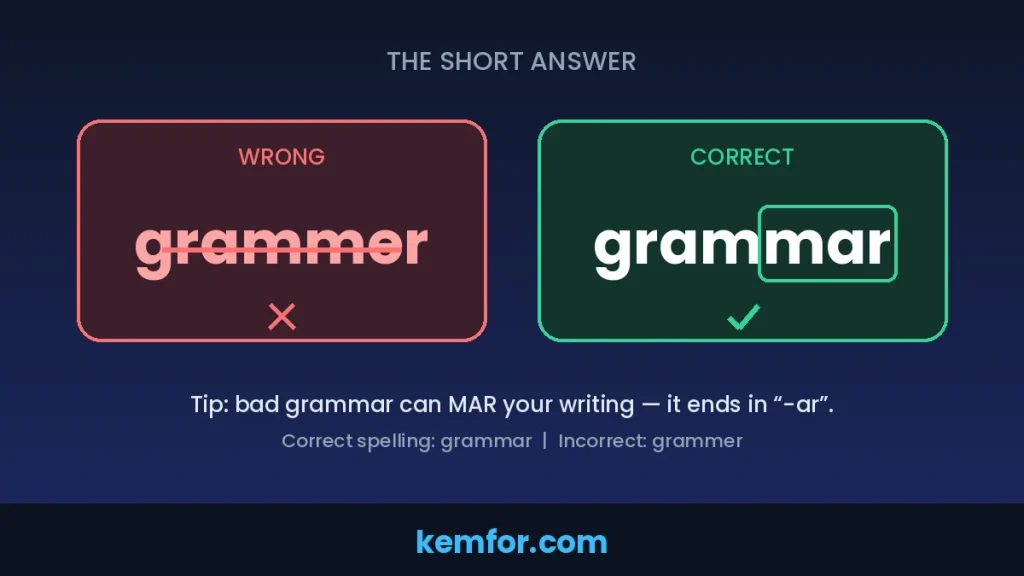
The correct spelling is grammar, ending in “-ar”. The form “grammer” is a misspelling in standard English, in both American and British usage. There is no regional variant that accepts it, unlike “color” and “colour” or “organize” and “organise.”
You can use these sentences as a reference:
- Correct: “Her grammar is excellent.”
- Correct: “He studies English grammar at night.”
- Incorrect: “Her grammer is excellent.”
The related forms follow the same pattern: grammarian, grammatical, ungrammatical, and grammatically. Notice that the adjective “grammatical” contains “-mat-”, which has no “e” anywhere. If you ever doubt the ending of the noun, think of those relatives.
One Exception Worth Knowing: The Surname
“Grammer” does exist as a proper noun. It is a family name, and the best-known bearer is the American actor Kelsey Grammer. When a person’s name is spelled that way, the spelling is correct for that person. As a common noun meaning the rules of a language, though, it is always “grammar.”
Why So Many People Write “Grammer”
A mistake this widespread is rarely random. Two forces push people toward the wrong ending, and both come from how English works.
The Sound Is Unstressed and Ambiguous
In normal speech, the final syllable of “grammar” is not stressed. English speakers reduce unstressed vowels to a neutral sound linguists call the schwa, the same sound you hear at the end of “teacher,” “doctor,” and “sugar.” Because the ending sounds identical whether you spell it -er, -or, -ar, or -re, the ear gives you no help. Your spelling has to come from memory, and memory is easily overwritten by more common patterns.
The Pull of the “-er” Ending
English has an enormous number of words ending in “-er”: teacher, farmer, writer, computer, number. The ending is by far the most familiar way to spell that final sound, especially for nouns that name a person or thing. When a brain meets an unfamiliar spelling decision, it reaches for the most common pattern. “Grammer” feels natural for exactly this reason, even though it is wrong.
Words ending in “-ar” are rarer and more arbitrary: calendar, collar, vinegar, similar, regular. Many of them share the misspelling problem. People write “calender,” “vinegar” as “vinegur,” and “similer.” Grammar belongs to the same family of spelling traps.
Where the Word “Grammar” Comes From
Knowing the history of a word often makes its spelling stick. Grammar has a long and interesting past.
From Greek Letters to English Classrooms
The word traces back to the Greek gramma, meaning a letter or something written. From it came grammatikē, an expression used for the art of letters, which the Romans borrowed as grammatica. In medieval Europe, “grammar” meant the study of Latin in particular. It was the first subject in the classical curriculum, the foundation on which logic and rhetoric were built. Old French turned the word into gramaire, and Middle English carried it forward in spellings such as gramer and gramery.
That medieval spelling variation matters, because it shows “gramer” was once an ordinary form. English spelling settled over the following centuries, and the “-ar” ending became the standard one, partly through influence from the Latin and French forms. When people write “grammer” today, they are unknowingly echoing a spelling that went out of fashion long ago.
The Surprising Link to “Glamour”
Here is a detail that rewards curiosity. The English word glamour is generally traced to a Scots alteration of “grammar.” In the past, learning was associated with mystery, and people who knew Latin and books were sometimes thought to hold magical or occult knowledge. The word for scholarly learning drifted toward meaning enchantment, and later toward the sense of attractive allure we use today. Few words changed so dramatically in meaning while keeping such a clear fingerprint of their origin.
Simple Memory Tricks to Spell Grammar Correctly
Rules help, but a good mnemonic is faster. These work because they attach the spelling to something you already know.
The “mar” trick. Remember this sentence: bad grammar can mar your writing. The word “mar” sits at the end of “grammar,” and the sentence is also true, which helps it stay in your head.
The “A-R” trick. Think of the two letters at the end as “A-R,” standing for “always right.” It is silly, and that is the point.
The relatives trick. Say “grammatical” out loud. The vowel after the “m” is an “a,” never an “e.” Let the longer word anchor the shorter one.
The double letters trick. Grammar has a double “m” in the middle and a single “r” at the end. Picture the word with two “m” letters standing like a pair of hills in the center.
Pick one that feels natural. Using it a handful of times is usually enough to lock the spelling in for good.
What Grammar Actually Means
Now that the spelling is settled, it helps to be precise about the thing itself. Grammar is the system of rules and patterns that governs how words combine to form meaningful phrases, clauses, and sentences in a language. It covers how words change form (morphology), how they are arranged (syntax), and how those arrangements carry meaning.
Every native speaker already knows an enormous amount of grammar without being taught it. No one has to explain to a child why “the big red ball” sounds right and “the red big ball” sounds odd. English speakers follow an unwritten ordering rule for adjectives, covering opinion, size, age, shape, color, and so on, without ever naming it. Formal study of grammar simply makes that hidden knowledge visible, so you can use it deliberately and fix it when it goes wrong.
Descriptive Versus Prescriptive Grammar
Two schools of thought shape how people talk about the topic, and understanding the difference saves a lot of arguments.
Descriptive grammar records how people actually speak and write. A linguist taking this approach observes, collects examples, and describes patterns without passing judgment.
Prescriptive grammar sets out how people are supposed to use the language according to an authority such as a style guide, a school curriculum, or an editor. Rules like “avoid ending a sentence with a preposition” or “use fewer for things you can count” are prescriptive.
Neither approach is wrong. Descriptive work explains why languages change, while prescriptive rules give writers a shared standard for formal settings. A skilled writer knows which standard the situation calls for.
The Core Building Blocks of English Grammar
You do not need to memorize a textbook to write well, but a working map of the territory helps enormously. English grammar rests on a few layers, each built on the one beneath.
The Parts of Speech
Traditional grammar sorts words into eight classes:
- Nouns name people, places, things, and ideas.
- Pronouns stand in for nouns.
- Verbs express actions, events, or states.
- Adjectives describe nouns.
- Adverbs modify verbs, adjectives, or other adverbs.
- Prepositions show relationships such as place, time, or direction.
- Conjunctions join words, phrases, or clauses.
- Interjections express sudden feeling.
Many modern grammars also recognize determiners (words like the, this, and some) as their own class, rather than folding them into adjectives. What matters is the habit of asking what job a word is doing in its sentence. The same word can change class depending on its role: “light” is a noun in “turn on the light,” an adjective in “a light jacket,” and a verb in “light the candle.”
Phrases, Clauses, and Sentences
Words group into phrases, and phrases build clauses. A clause contains a subject and a predicate. An independent clause can stand alone as a sentence, while a dependent clause cannot. “Because the train was late” is a dependent clause, and it leaves the reader waiting. Add an independent clause, “we missed the meeting,” and the thought is complete.
Understanding this structure is the key to controlling sentence length, avoiding fragments, and recognizing run-on sentences before an editor does.
The Most Common Grammar Mistakes and How to Fix Them
Most errors come from a small number of recurring problems. If you correct these, the quality of your writing rises noticeably.
Subject-Verb Agreement
The verb must agree with its true subject, not with whatever noun sits closest to it. In “The list of requirements are long,” the subject is “list,” so the sentence should read “The list of requirements is long.” Distance between subject and verb is the usual cause of this slip.
Misplaced and Dangling Modifiers
A modifier should sit next to the word it describes. “Walking down the street, the trees looked beautiful” says the trees were walking. Fix it by naming the walker: “Walking down the street, I thought the trees looked beautiful.”
Comma Splices and Run-Ons
Joining two independent clauses with only a comma creates a comma splice: “The report was late, we missed the deadline.” Repair it with a period, a semicolon, or a conjunction: “The report was late, so we missed the deadline.”
Apostrophe Confusion
Its is possessive and it’s means “it is” or “it has.” The pair causes more mistakes than almost any other, partly because possessive nouns elsewhere do take apostrophes. When unsure, expand “it’s” to “it is” and see whether the sentence still works.
Unclear Pronoun Reference
When a pronoun could point to more than one noun, the reader has to guess. “When Maria told Dana that she had won, she was thrilled” leaves two possible meanings. Naming the person again removes the doubt.
Grammar, Spelling, Punctuation, and Usage: Not the Same Thing
People often use “grammar” as a catch-all for anything that looks wrong in a sentence. In practice, several separate areas are involved, and separating them makes problems easier to diagnose.
Spelling concerns how individual words are written. Writing “grammer” is a spelling error, not a grammar error, which is a slightly ironic fact.
Punctuation covers the marks that organize written language: commas, periods, colons, and so on. It overlaps with grammar but follows its own conventions.
Usage covers word choice and conventions, such as the difference between affect and effect, or whether data takes a singular or plural verb.
Grammar proper concerns structure: agreement, tense, word order, and clause construction.
When you review your own writing, check each layer in turn. Reading for structure, then for word choice, then for spelling and punctuation, catches far more than a single pass ever does.
Why Grammar Matters in Professional and Online Writing
Correct grammar is not about showing off. It affects how readers judge you before they have consciously decided anything.
In business writing, errors are small signals that can raise doubts about care and reliability. A proposal with a clear structure and clean sentences feels trustworthy, while one with agreement problems and stray apostrophes asks the reader to look past the mistakes to reach the message.
For website owners and content creators, the situation has a technical side too. Google has not confirmed grammar as a direct ranking factor, and a single typo will not sink a page. But its guidance on helpful, people-first content emphasizes quality, clarity, and trustworthiness, and poorly written text undermines all three. Readers who struggle with a page leave it, and that behavior matters whatever the algorithm does. Good grammar is best understood as a part of overall content quality and credibility.
There is also a human reason. Clear sentences respect the reader’s time. Ambiguity forces people to work harder, and most will not.
A Practical Routine for Improving Your Grammar
Grammar improves through steady, deliberate habits more than through cramming. This routine works for students, professionals, and anyone writing in English as a second language.
Read widely and attentively. Well-edited books, magazines, and quality journalism expose you to correct structures repeatedly. Pay attention to how sentences are built, not only to what they say.
Read your writing aloud. Your ear catches awkward rhythm and missing words that your eye skips. This single habit eliminates a surprising share of errors.
Keep an error log. Note the mistakes you actually make. Most people repeat the same five or six, and a short personal list of fixes is more useful than a general rulebook.
Edit in separate passes. First check meaning and structure, then grammar, then spelling and punctuation. Trying to do everything at once leads to missed problems.
Wait before proofreading. Even a short break, such as an hour or overnight, makes your own mistakes easier to see.
Consult a reliable reference. Keep one dependable style guide or grammar handbook and use it when you are unsure, rather than relying on memory or guesses.
Grammar Checkers: Useful Tools With Real Limits
Automated tools are helpful, and most writers benefit from them. They catch typos, missing commas, repeated words, and many agreement errors quickly. Built-in spell checkers will flag “grammer” immediately and suggest the correct form.
But these tools have limits. They can misread context, suggest changes that alter your meaning, and miss errors that are valid words in the wrong place, such as “their” when you meant “there.” They also tend to flatten style, nudging every sentence toward the same plain pattern.
Treat a checker as a second pair of eyes, not as an editor. Accept a suggestion only when you understand why it is right. This is also the best way to learn from the tool, because each correction you comprehend becomes a lesson you keep.
Teaching and Learning Grammar Effectively
How grammar is taught makes a large difference to whether it sticks. Endless drills on isolated rules often fail because learners cannot connect them to real writing.
A better approach ties each rule to a purpose. Instead of memorizing the definition of a dependent clause, a learner can practice combining two short, choppy sentences into one smooth one and see the benefit. Correcting errors in real pieces of the learner’s own writing is more motivating than correcting invented examples.
For people learning English as an additional language, patterns matter more than lists of exceptions. Articles (a, an, the), verb tenses, and prepositions are the usual stumbling blocks, because many languages handle them differently or not at all. Regular exposure to natural English, combined with targeted practice on a learner’s own recurring errors, produces steadier progress than trying to master every rule at once.
For parents and teachers working with children, the most effective foundation is a home or classroom full of language: conversation, stories read aloud, and gentle modeling of correct forms rather than constant correction.
Language Changes: Are Today’s Rules Final?
Grammar is not a fixed monument. It shifts, slowly but constantly. Rules that were once insisted upon have relaxed, and new conventions have arrived.
A clear example is the singular they, used for one person whose gender is unknown or irrelevant, or who prefers it. It has appeared in English for centuries, and many major style guides, including APA and Chicago, now accept it. Another is the steady decline of whom in everyday speech, even as it survives in formal writing.
This does not mean anything goes. In professional and academic settings, following the conventions of your audience and style guide is the safest choice. The practical lesson is to know the standard, understand why it exists, and recognize that good judgment sometimes means choosing the form your particular readers will find clearest.
Conclusion
The answer to the original question is simple: grammar is correct, and grammer is a misspelling. The mix-up happens because the final syllable of the word is unstressed and because English is crowded with “-er” endings that pull the ear and the fingers in the wrong direction. A memory trick such as “bad grammar can mar your writing” is usually enough to fix it permanently.
Beyond the spelling, grammar is a living system that shapes how clearly and credibly you communicate. Learn the building blocks, watch for the handful of errors that cause most problems, read aloud, edit in passes, and use tools wisely rather than blindly. Those habits improve writing steadily, and they cost nothing but attention.
Frequently Asked Questions About Grammar and Grammer
Is it “grammar” or “grammer”?
The correct spelling is “grammar.” “Grammer” is a misspelling in standard English. The only time “Grammer” is correct is as a surname, such as that of actor Kelsey Grammer.
Is “grammer” ever acceptable in British English?
No. British and American English both spell the word “grammar.” Unlike “colour” and “color,” there is no regional variation for this word.
Why does my spell checker keep underlining “grammer”?
Because it is not a recognized English word outside of proper names. Most spell checkers will offer “grammar” as the correction automatically.
What is the easiest way to remember how to spell grammar?
Use the sentence “bad grammar can mar your writing.” The word “mar” appears at the end of “grammar,” which anchors the correct ending.
Is grammar the same as spelling?
No. Grammar concerns the structure of sentences, such as agreement, tense, and word order. Spelling concerns how individual words are written. They work together, but they are separate skills.
Does grammar affect SEO and search rankings?
Google has not stated that grammar is a direct ranking factor. However, clear, well-edited writing supports the content quality, trust, and readability that Google’s guidance for helpful content emphasizes, and it keeps readers engaged.
How can I improve my grammar quickly?
Read your writing aloud, keep a short log of your most frequent mistakes, edit in separate passes, and check unfamiliar rules in a trusted style guide. Consistent practice on your own writing works better than memorizing rules in isolation.