Almost everyone has stared at a word they’ve typed a thousand times and suddenly stopped trusting it. “Calendar” is one of those words. Two vowels sit in places where the ear can’t tell them apart, and the result is a spelling that feels slightly wrong no matter which way you write it.
What makes this case unusual is that the wrong-looking version isn’t a pure invention. “Calender” is a legitimate English word. It just means something entirely different, and you will almost certainly never need it. This guide explains which spelling to use, what the other one actually means, where both words came from, and how to keep them straight for good.
The Short Answer
Calendar is the correct spelling for the system of organizing days, weeks, and months, and for the printed or digital object that displays them. If you are writing about dates, appointments, deadlines, holidays, or schedules, you want calendar, spelled with -ar at the end.
Calender is a separate, specialized word. It refers to a machine with heavy rollers that presses and smooths materials such as paper, fabric, and plastic. It also works as a verb for that process.
In ordinary writing, “calender” is a typo roughly 99 times out of 100. Unless you work in paper milling, textile finishing, or rubber manufacturing, you can safely commit to calendar every time.
What Does “Calendar” Mean?
The word covers more ground than most people notice. Understanding its range helps explain why it’s so common and why the spelling deserves to be automatic.
Calendar as a System for Organizing Time
At its core, a calendar is a structure for dividing time into recognizable units. The Gregorian calendar, which most of the world uses for civil purposes, arranges the year into twelve months of varying length. Other systems exist alongside it: the Islamic Hijri calendar follows lunar months, the Hebrew calendar blends lunar and solar cycles, and the Chinese calendar is also lunisolar. Each of these is a calendar, and none of them is ever a “calender.”
Calendar as a Physical or Digital Object
Most people encounter the word in everyday objects: the wall calendar from a local business, the desk planner, the phone app that buzzes before a meeting. Digital tools such as Google Calendar, Apple Calendar, and Outlook Calendar have made the word more visible than at any point in history. If you’ve ever typed “add to calendar,” you’ve used the word correctly.
Calendar in Specialized Contexts
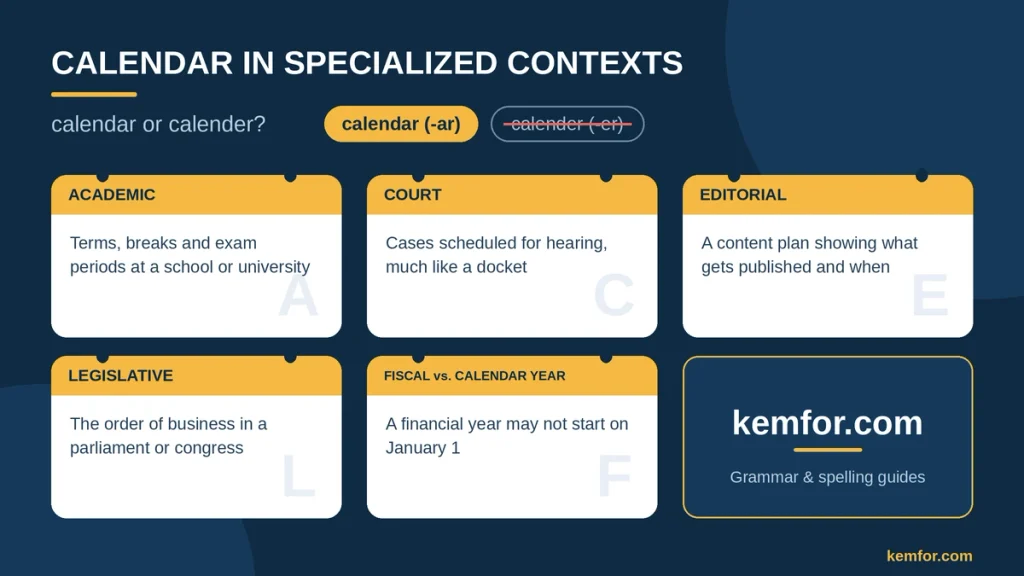
The word stretches well beyond dates on a wall. You will see:
- Academic calendar: the schedule of terms, breaks, and exam periods at a school or university.
- Court calendar: a list of cases scheduled for hearing, often interchangeable with “docket.”
- Editorial or content calendar: a plan for what gets published and when.
- Legislative calendar: the order of business in a parliament or congress.
- Fiscal vs. calendar year: a distinction that matters in accounting, where a company’s financial year may not begin on January 1.
Calendar as a Verb
Less commonly, calendar works as a verb meaning to enter something in a calendar or schedule it, as in “the committee calendared the hearing for March.” It’s mostly formal or legal usage, but the spelling stays the same.
What Does “Calender” Mean?
Now for the word you probably don’t need, but should recognize.
Calender as a Rolling Machine
A calender is a set of two or more heavy, smooth rollers through which a material is passed under pressure. The purpose is to flatten it, give it a uniform thickness, or produce a glossy or textured surface. Imagine dough going through a pasta roller, scaled up to industrial size and applied to paper, cloth, or sheets of plastic.
Calendering in Industry
The process is called calendering, and it appears in several manufacturing fields:
- Paper: calendering controls smoothness and gloss, which affects how well ink sits on the surface. Coated magazine stock often passes through a calender stack.
- Textiles: fabrics can be calendered to give them a sleek, sometimes lustrous finish.
- Rubber and plastics: sheet products like vinyl flooring, plastic film, and rubber sheeting are often formed by feeding warm material between rollers.
If you’re reading a technical document about any of these, “calender” is spelled correctly. In everything else, treat it with suspicion.
An Older, Rarer Meaning
There is a third use that appears in older literature: a calender was also a wandering mendicant, a type of itinerant dervish associated with Sufi traditions. The word shows up in translations of classical tales and in some historical English texts. It’s now archaic, but it’s another reason the spelling exists as a legitimate dictionary entry rather than a pure error.
Calendar vs. Calender: A Side-by-Side Comparison
| Feature | Calendar | Calender |
|---|---|---|
| Ending | -ar | -er |
| Core meaning | System or display of days, weeks, months | Roller machine for pressing materials |
| Typical context | Scheduling, planning, history, apps | Paper, textile, and plastics manufacturing |
| Verb form | calendar, calendared, calendaring | calender, calendered, calendering |
| Frequency in everyday writing | Extremely common | Very rare |
| Likely to be what you want? | Almost always | Almost never |
Where These Words Come From
The two spellings look like near-twins, but their family trees are entirely separate. Knowing that makes the distinction feel less arbitrary.
The Roman Roots of “Calendar”
Calendar traces back to the Latin word kalendae (also written calendae), the name the Romans gave to the first day of each month. The term is linked to the verb calare, meaning “to call out” or “to proclaim.” In early Rome, priests reportedly announced the arrival of the new moon and declared what the coming weeks held.
The first of the month also carried financial weight. Debts and interest were commonly due on the calends, and the Latin kalendarium came to mean an account book listing those obligations. Through medieval Latin and Old French, the word entered English, where it gradually shifted from “account book” to “table of days and months.”
So the word calendar began life with deadlines attached. That’s a fitting heritage for something we still use to track due dates.
The Roots of “Calender”
The machine-word has a different origin. It comes through French from Latin cylindrus and, before that, Greek kylindros, meaning “roller” or “cylinder.” The link makes obvious sense: a calender is a cylinder-based device. It has nothing to do with Roman months and everything to do with rolling.
Middle English spellings of both words wandered around, with forms like kalender and calender applied to what we now call a calendar. That overlap in the historical record is one reason the confusion has such long roots.
Why People Confuse the Two
Several forces push writers toward the wrong spelling.
The unstressed vowel problem. In most English accents, the final syllable of “calendar” is a weak, reduced sound, often rendered as a schwa. Whether it is written -ar, -er, or -or, it sounds nearly identical. The ear gives you no clue, so spelling has to be memorized.
Pattern interference. English is full of agent and instrument words ending in -er: teacher, printer, roller, scanner. When you’re unsure, the -er ending feels like the safe default. Words ending in -ar (regular, popular, similar, familiar) are less predictable, and calendar belongs to that smaller group.
Autocorrect inconsistency. Spell checkers accept “calender” because it’s a real word, so they won’t flag it. A typo that happens to be a valid dictionary entry is the hardest kind to catch, which is why “calender” survives in published emails, web pages, and even official notices.
Other Common Misspellings
“Calender” isn’t the only way the word goes wrong. You may also run into:
- Calander: the a and e are swapped in the middle.
- Calandar: the first vowel pair is flipped but the ending is right.
- Calendr or calenadr: typing slips, usually from fast keyboard work.
Only one arrangement is correct: c-a-l-e-n-d-a-r. The two middle letters read “-en-” and the word closes with “-ar.”
Memory Tricks That Actually Work
Mnemonics are only useful if they stick, so here are a few built around logic rather than rhyme.
The roller trick. A calender is a machine with roll-ers. Both words share the -er ending. If you can’t picture rollers pressing something flat, you don’t want the -er spelling.
The “-ar” in “dollar” trick. Think of money and dates together: dollar and calendar both end in -ar, and both tend to show up around due dates. This pairing is oddly effective because it recalls the word’s origin as an account book.
The two A’s trick. Look at the letters: c-a-l-e-n-d-a-r. The word contains an a near the start and another near the end, bookending the e and n in the middle. Hold the two A’s in mind and the e tends to stay in the center where it belongs.
The default-rule trick. If you aren’t writing about industrial pressing, always choose calendar. A simple rule that you never have to think about beats a clever mnemonic you have to recall.
Calendar and Calender in Real Sentences
Seeing the words in context makes the difference concrete.
Correct Uses of “Calendar”
- “I’ve blocked off Thursday afternoon on my calendar.”
- “The school released its academic calendar for the coming year.”
- “Our content calendar lists every post through December.”
- “The Gregorian calendar replaced the Julian system in Catholic countries beginning in 1582.”
- “She asked me to calendar the deadline so nobody forgets it.”
Correct Uses of “Calender”
- “The mill installed a new calender to improve the gloss of its coated paper.”
- “After the fabric is dyed, it’s calendered to give it a smooth surface.”
- “The plastics plant feeds heated polymer through a calender to form thin sheets.”
Notice that every “calender” example belongs to a manufacturing setting. If your sentence mentions a meeting, a birthday, or a due date, the word you need is calendar.
Calendaring vs. Calendering
The same confusion carries into the -ing forms, and here the stakes are slightly higher because both terms appear in professional vocabulary.
Calendaring refers to managing a schedule: coordinating meetings, sending invites, or syncing diaries across a team. Software vendors use it when describing scheduling features.
Calendering refers to the roller-pressing process in manufacturing.
A project manager who writes “calendering” in a status update has accidentally described a paper finishing step instead of a scheduling task. It’s an easy slip, and it’s worth watching for when you edit workplace documents.
American vs. British English
Here’s some reassuring news: there is no regional split. Unlike color/colour or organize/organise, the spelling of calendar is identical in American, British, Canadian, Australian, and Indian English. You don’t need to adjust for audience. The same applies to calender in its technical sense.
Why the Right Spelling Matters
A single wrong vowel might seem trivial, but it carries real weight in a few situations.
Professional credibility. In client emails, proposals, and public announcements, a spelling slip in a common word can undermine the impression of care. Readers rarely articulate this, but they notice.
Search visibility. If you run a website that offers scheduling templates, planners, or printable monthly layouts, spelling consistency affects how people find you. Search engines are good at interpreting misspellings, but pages that use the standard form align most reliably with what users type and expect.
Technical clarity. In industrial and engineering documents, mixing up the two words can introduce genuine ambiguity, since each refers to something specific within its field.
Practical Tips for Writers and Editors
A few habits will close the gap between knowing the rule and applying it under deadline pressure.
- Search your draft for “calender.” If you’re not writing about manufacturing, every hit is an error. A quick find-and-replace sweep takes seconds.
- Don’t rely on spell check alone. Because “calender” is a legitimate word, many tools will pass it without comment. Grammar checkers with context awareness do better, but not perfectly.
- Read headings and button labels twice. Errors cluster in places people stop proofreading: navigation menus, captions, form fields, and email subject lines.
- Keep a house style note. Teams that publish regularly benefit from a short list of frequently misspelled words. Calendar belongs on that list.
- Consider context first. Before changing any instance, ask whether the text is about dates or about rolling machinery. The topic decides the spelling.
Conclusion
The answer to “calendar or calender” is straightforward. Calendar is the word for the structure of days and months and for every planner, app, and wall hanging that displays them. Calender is a niche term from industrial finishing, with a quiet historical meaning that most readers will never encounter.
The two words come from different ancestors: one from Roman month-beginnings and account books, the other from the Greek word for a cylinder. They only look alike because English spelling has a habit of bringing unrelated words close together. If you remember that a calender has rollers, and everything else is a calendar, you’ll rarely hesitate again.
Frequently Asked Questions
Is it “calendar” or “calender”?
It is calendar. That is the standard spelling for the system of dates and for any object or app that displays them. “Calender” exists as a separate word but has a completely different meaning.
Is “calender” ever correct?
Yes, in specific contexts. It names a roller machine used to smooth and finish paper, fabric, rubber, and plastic, and it also serves as a verb for that process. It is also an older term for a type of wandering mendicant in some historical texts. For anything involving dates or schedules, it is wrong.
Why does spell check sometimes miss “calender”?
Because it is a real dictionary word, many basic spell checkers treat it as acceptable. Only a tool that analyzes the surrounding sentence is likely to suggest the correction, and even those can miss it.
What is the origin of the word “calendar”?
It descends from the Latin kalendae, the first day of the Roman month, and from kalendarium, an account book used to track debts due on that day. It passed through medieval Latin and Old French before settling into English.
What does “calender” come from?
It comes from French, ultimately from Latin cylindrus and Greek kylindros, meaning “roller” or “cylinder.” That’s why the word describes a machine built around rollers.
Is “calander” a correct spelling?
No. “Calander” is a common misspelling. The correct form is c-a-l-e-n-d-a-r, with -en- in the middle and -ar at the end.
Is there a difference between American and British spelling?
No. Calendar is spelled the same way in every major variety of English.
What’s the easiest way to remember the correct spelling?
Link calender to rollers, since both end in -er. Anything else, including dates, meetings, holidays, and planners, gets calendar with -ar. If you aren’t writing about manufacturing, use calendar.
What’s the difference between “calendaring” and “calendering”?
Calendaring means scheduling or managing events on a calendar. Calendering is the industrial process of pressing material between rollers.
Can “calendar” be used as a verb?
Yes, though it is less common and most often appears in formal or legal writing. It means to enter an item in a calendar or schedule it, as in “the court calendared the hearing for next month.”