Few words trip up confident writers as reliably as this one. You type it a hundred times a year, on invoices, review sites, text messages, and wedding invitations, and every so often your eyes catch something odd. Is that a-u-r-a-n-t or a-r-a-u-n-t? Does the word want an extra letter somewhere?
The answer is short: restaurant is the only correct spelling. Restaraunt is a misspelling, one of the most common attempts at the word in English. The rest of this guide explains why the mistake happens, what the word’s history tells us about its odd letter pattern, and how to lock in the right version permanently.
Restaurant or Restaraunt: The Quick Answer
Write restaurant. The letters run in this order: r-e-s-t-a-u-r-a-n-t. That is eleven letters, with the vowel pair au sitting in the middle and a clean -ant ending.
Restaraunt scrambles the middle. It moves the a and u around so that the word ends in -aunt, which looks natural because English has many -aunt words, such as haunt, daunt, taunt, and gaunt. Your eye accepts the wrong version because it matches a familiar pattern.
- Correct: We booked a table at a small Lebanese restaurant near the station.
- Incorrect: We booked a table at a small Lebanese restaraunt near the station.
No dictionary lists restaraunt as an accepted variant. It is not a British spelling, an American spelling, or an older form. It is simply an error.
Why So Many People Write Restaraunt
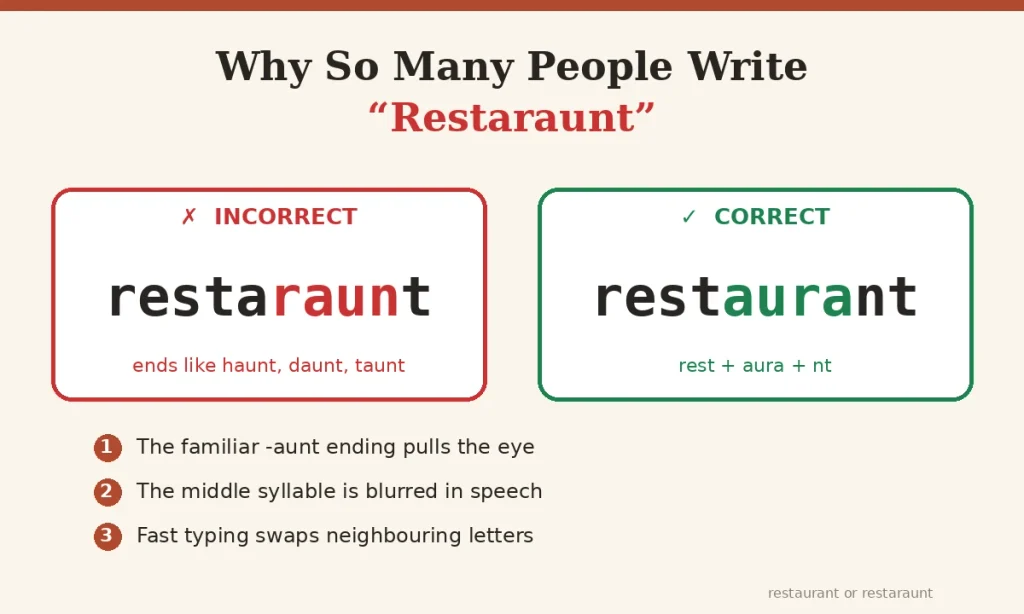
Misspellings are rarely random. They usually reveal how our brains process words, and restaraunt is a good case study.
The Pull of the -aunt Pattern
Words ending in -aunt are common and memorable. When you reach the end of a long word and feel uncertain, your memory reaches for the nearest familiar ending. Restaurant’s genuine ending, -rant, is far less distinctive, so the brain swaps it for something more comfortable.
Sound Misleads the Spelling
Say the word the way most people do in casual speech and you may produce something like “RES-trawnt” or “RES-tuh-rawnt.” The sound at the end is a broad aw-type vowel followed by nt. English spelling offers -aunt as a tidy match for that sound, which nudges writers toward the wrong choice. Restaurant keeps a spelling that reflects its French origin rather than its English pronunciation.
The Silent Middle Syllable
Many speakers compress the word to two syllables: “RES-trant.” That means the a and u in the middle never get pronounced distinctly. When letters have no audible job, writers forget where they belong. This is the same reason people stumble over library, February, and comfortable.
Fast Typing and Autocorrect Fatigue
Typing speed also plays a part. Fingers swap neighboring letters easily, and a and u sit close enough in the word’s flow that a transposition feels natural. Modern spell checkers usually catch restaraunt, but only if you have them switched on and only if you read the red underline before hitting send.
Anatomy of the Word: Breaking Restaurant into Pieces
The simplest way to stop guessing is to see the word as three small blocks instead of one long string.
rest + aura + nt
Each block is something you already know:
- Rest: the same word you use for taking a break.
- Aura: a real English word meaning a distinctive atmosphere or quality.
- nt: the closing consonants.
Put them together and you get rest-aura-nt. If you can spell rest and aura, you can spell restaurant. Notice also that this decomposition makes it obvious why restaraunt is wrong: nothing in the word resembles -aunt.
As a bonus, the image is easy to carry in your head. A restaurant is a place with its own aura, and that is a fair description of the best ones.
The Origin of Restaurant
The spelling feels irregular because the word is borrowed. English took it from French, and French took it from a verb meaning “to restore.”
From Restoring to Dining
The French verb restaurer means to restore or to renew, and it descends from Latin restaurare. The same family gave English the words restore, restoration, and restorative. In older French usage, a restaurant was a food or drink meant to restore strength, usually a rich, concentrated broth served to someone who was tired or unwell.
The Paris Story
A popular account credits a Parisian called Boulanger, around the 1760s, with serving restorative broths in a shop and giving the word its new meaning as a place. Historians treat that tale with caution, and the precise origin of the dining establishment is debated. What is well supported is the broader picture: by the late eighteenth century, Paris had businesses offering individually ordered meals at set hours, and the word restaurant came to describe the place rather than the broth.
Arrival in English
English adopted the word in the early nineteenth century, when the French style of dining out became fashionable in Britain and America. Borrowed words often keep their original spelling even when English speakers pronounce them differently, and restaurant is a textbook example. The au pair is French spelling logic, not English logic, which is why it feels slightly foreign on the page.
How to Pronounce Restaurant
Pronunciation varies, and none of the common versions is wrong. What matters for spelling is that the written word stays fixed while speech drifts around it.
American Pronunciation
Most American speakers say either “RES-tuh-rahnt” with three syllables or “RES-trahnt” with two. Both are standard.
British Pronunciation
In Britain you will hear “RES-tuh-ront” or “RES-tron.” Some speakers, especially in more formal or older registers, lean closer to the French nasal ending. The end vowel is typically shorter than in American English.
Why Pronunciation Cannot Be Your Spelling Guide
Because speakers drop or blur the middle syllable, the spoken word gives you little help with the letters. A useful rule here is to stop spelling by ear. When a word has been borrowed from another language, memorize its shape instead of sounding it out.
Memory Tricks That Make Restaurant Stick
You do not need heavy grammar knowledge for this one. A few mental hooks are enough.
The Rest-Aura-NT Method
Visualize the three blocks from earlier. Write them with small gaps a few times on paper, then close the gap. Doing this twice or three times is usually enough to make the pattern automatic.
The “AU Comes Before RA” Cue
In restaurant, the au appears first and the ra comes second: -taurant. If you ever feel the urge to write -raunt, remember that the a-u pair arrives before the r-a pair. A short phrase helps: “au, then ra.”
The Restaurateur Link
The related word restaurateur, meaning someone who owns or manages a restaurant, shows the same -aur- core. If you can picture that cousin word, the shared middle reminds you that aur belongs together.
Write It Slowly Once
Spelling memory is partly muscle memory. Type or handwrite the word slowly five times, concentrating on the middle. It sounds childish and it works.
Common Misspellings of Restaurant
Restaraunt has plenty of company. Here are the errors that appear most often, along with what goes wrong in each.
| Misspelling | What Went Wrong | Correct Form |
|---|---|---|
| restaraunt | Letters shifted so the ending looks like -aunt | restaurant |
| resturant | The a after t is dropped | restaurant |
| restarant | The u is dropped | restaurant |
| restraunt | The middle syllable is collapsed and -aunt is borrowed | restaurant |
| restaurent | The ending becomes -ent, as in student or resident | restaurant |
| restuarant | u and a swapped, as in actual | restaurant |
| resteraunt | An e is added and the ending drifts to -aunt | restaurant |
| restauraunt | An extra u creeps into the ending | restaurant |
If you notice, nearly every wrong version either shortens the word or moves the a and u. The correct version asks you to keep both letters and keep them in order.
Restaurateur or Restauranteur?
Writers who correctly spell restaurant sometimes fall into a second trap with the person who runs one.
The standard form is restaurateur, with no n before the t. It comes straight from French, and it stays close to restaurer, the root verb, which also has no n. The version with an n, restauranteur, appears frequently because it feels logical: if the place is a restaurant, the owner should be a restaurant-er.
Even so, style-conscious writers, editors, and many publishers use restaurateur in professional writing. If you are writing for a business audience, press release, or formal profile, that is the safer choice.
- Preferred: The restaurateur opened her third location in March.
- Frequently seen, but avoid in formal writing: The restauranteur opened her third location in March.
British and American English: Is There a Difference?
Here the news is simple: there is none. Both varieties spell the word restaurant. You will not find a regional variant like colour/color or theatre/theater.
What does differ slightly is vocabulary around the word. British writers may say “eatery” or “café” in casual contexts, and Americans might say “diner” or “joint.” Neither affects the spelling of restaurant itself.
Plurals, Possessives, and Capitalization
Once the spelling is secure, the surrounding grammar is easy.
Plural
Add an s: restaurants. No other change is needed.
- There are more than forty restaurants within walking distance of the old market.
Possessive
For one restaurant, use restaurant’s. For several, use restaurants’.
- The restaurant’s terrace overlooks the river.
- Both restaurants’ menus changed after the new chef arrived.
Capitalization
Use lowercase when speaking generally. Capitalize only when the word is part of a proper name.
- We ate at a restaurant downtown.
- We ate at Karachi Kitchen Restaurant downtown.
Compound Forms
Compound words built around restaurant are mostly written as separate words or with a hyphen, depending on the style guide: restaurant review, restaurant owner, restaurant-quality. When in doubt, check the guide that governs your publication.
Restaurant in Other Languages
Looking at related words in other languages shows how stable this word is.
- French: restaurant, spelled exactly as in English.
- Spanish: restaurante, with a final e.
- Portuguese: restaurante.
- German: Restaurant, capitalized as all German nouns are.
- Italian: ristorante, using the -ist- pattern.
If you know a Romance language, the cross-linguistic pattern can help you remember the central -aur- sound. English and French share the exact same shape, which is one reason the French connection is the best guide to the spelling.
Words Related to Restaurant
Understanding the vocabulary around the word can sharpen your writing and expand your options.
Related Terms for Places to Eat
- Café: typically lighter fare, coffee, and pastries.
- Bistro: a small, casual restaurant, often with a French or European style.
- Diner: a casual, informal restaurant, especially in American usage.
- Eatery: a general, informal term for any place that serves food.
- Brasserie: originally a brewery, now a restaurant with a relaxed atmosphere.
- Canteen: a dining hall in a school, workplace, or institution.
Related Terms for People and Roles
- Restaurateur: an owner or manager of restaurants.
- Chef: a professional cook, usually in charge of a kitchen.
- Server or waiter: the person who takes orders and brings food.
- Maître d’: the head of the front-of-house staff.
- Diner (person): a customer eating at a restaurant.
Phrases You May Need
Common phrases include restaurant review, restaurant industry, restaurant reservation, and fine-dining restaurant. Each uses the standard spelling without exception.
Why Correct Spelling Matters for Restaurant Businesses
If you run or market a restaurant, spelling is more than a grammar point. It is a signal.
First Impressions on Menus and Signs
A menu is often the first piece of writing a customer reads about your business. A misspelled word on a sign or menu can make people wonder what else is handled carelessly. Many diners are forgiving, but some are not, and screenshots of menu errors travel quickly online.
Search Visibility
People search for restaurants constantly, using phrases like “restaurants near me” or “best restaurant in [city].” Search engines are good at interpreting typos, but your website, listings, and social profiles should still use the correct spelling so that your business matches what people expect to find. Consistent spelling also helps your listings look credible across directories and review platforms.
Professional Documents
Contracts, licenses, press releases, and investor materials all carry weight. In these documents, even small errors can undermine trust. Treat spelling the way you treat accounting: boring, necessary, and worth checking twice.
A Simple Proofreading Routine
You do not need a long process. Three quick steps catch most spelling errors involving this word.
- Search the document. Use the find tool to search for common wrong versions: “restaraunt,” “resturant,” “restarant,” “restraunt,” and “restaurent.” If the tool turns up any hit, fix it.
- Read the word aloud as rest-aura-nt. Slowing down at the middle makes visual errors easier to see.
- Check names separately. Some business owners deliberately use unusual spellings in a brand name. Confirm any unusual spelling against the business’s own website before assuming it is wrong.
Spell checkers help, but they miss context. A word that is spelled correctly but used wrongly will pass. A quick human review remains the best protection.
Restaurant in Real Sentences
Seeing the word in context helps lock in the pattern.
- The restaurant on the corner serves breakfast until noon.
- She wrote a thoughtful restaurant review that praised the service and criticized the lighting.
- Our team booked a private room at a restaurant that specializes in slow-cooked lamb.
- The restaurant industry depends heavily on seasonal staff.
- He worked his way from dishwasher to restaurateur in fifteen years.
- Every restaurant in the neighborhood closed early during the storm.
- They chose the restaurant because the reviews mentioned a quiet atmosphere.
Read these a couple of times. The point is not memorizing sentences but letting your eyes absorb the correct shape.
Conclusion
Restaurant is the correct spelling, and restaraunt is an understandable but incorrect attempt at a word that does not behave like English. The au in the middle is a gift from French, the -ant ending is simple once you see it, and the rest + aura + nt breakdown turns a tricky word into three easy pieces. Add a quick search for the common misspellings before you publish, and the problem disappears.
Spelling confidence is built from small, repeatable habits rather than talent. Use the memory tricks, check your documents, and the next time you write about a great place to eat, the word will come out right without a second thought.
Frequently Asked Questions
Is it restaurant or restaraunt?
It is restaurant. Restaraunt is a misspelling that appears because the ending resembles other English words like haunt and taunt.
How do you spell restaurant correctly?
Spell it r-e-s-t-a-u-r-a-n-t. A helpful way to remember it is to split it into rest, aura, and nt.
Why is restaurant so hard to spell?
The word comes from French, so its spelling does not follow typical English sound-to-letter patterns. Many speakers also blur or skip the middle syllable when talking, which makes the au pair easy to forget.
Is restaurateur spelled with an n?
No. The standard spelling is restaurateur, without an n. The form restauranteur is common in casual use but is generally avoided in careful professional writing.
Is there a British spelling of restaurant?
No. British and American English both use the same spelling, restaurant.
Where does the word restaurant come from?
It comes from the French verb restaurer, meaning to restore, which in turn comes from Latin. It originally referred to a restorative food or broth before being applied to the places that serve meals.
Can I use “resturant” in informal writing?
It is still a misspelling, even in casual messages. Using the correct spelling costs nothing and avoids confusion, especially in anything public such as reviews, posts, or business listings.
What is the plural of restaurant?
The plural is restaurants. For possession, use restaurant’s for one and restaurants’ for several.
How can I stop making this mistake?
Break the word into rest-aura-nt, write it slowly a few times, and use the find tool to search for common misspellings before you publish. Within a week or two, the correct form usually becomes automatic.