You are typing quickly, the sentence is nearly finished, and a small doubt creeps in. Is it “I’m stopping by later” or “I’m stoping by later”? The second version looks almost right, which is exactly why it slips through so many emails, essays, and product pages.
The short answer is that “stopping” is the correct spelling of the -ing form of the verb stop. “Stoping” is a real word, but it belongs to underground mining, where it describes how ore is removed. Outside that trade, it is a typo.
This guide goes beyond the one-line answer. You will see why English doubles the p, where the confusion comes from, what miners mean by “stoping,” how the two words sound, and how to make sure the wrong one never reaches your readers.
Quick Answer: Write “Stopping” in Almost Every Situation
Use stopping whenever you mean ceasing, pausing, halting, blocking, or making a brief visit. That covers more than 99 percent of the situations in which people write the word.
- The train is stopping at every station today.
- Stopping the project now would waste months of work.
- We’ll be stopping by the bakery on the way home.
Reserve stoping for technical writing about mining, where it names the process of excavating ore and leaving an open void called a stope. If your sentence has nothing to do with mines, “stoping” is a spelling error, however natural it looks on the screen.
Why “Stopping” Has Two P’s: The Doubling Rule Explained
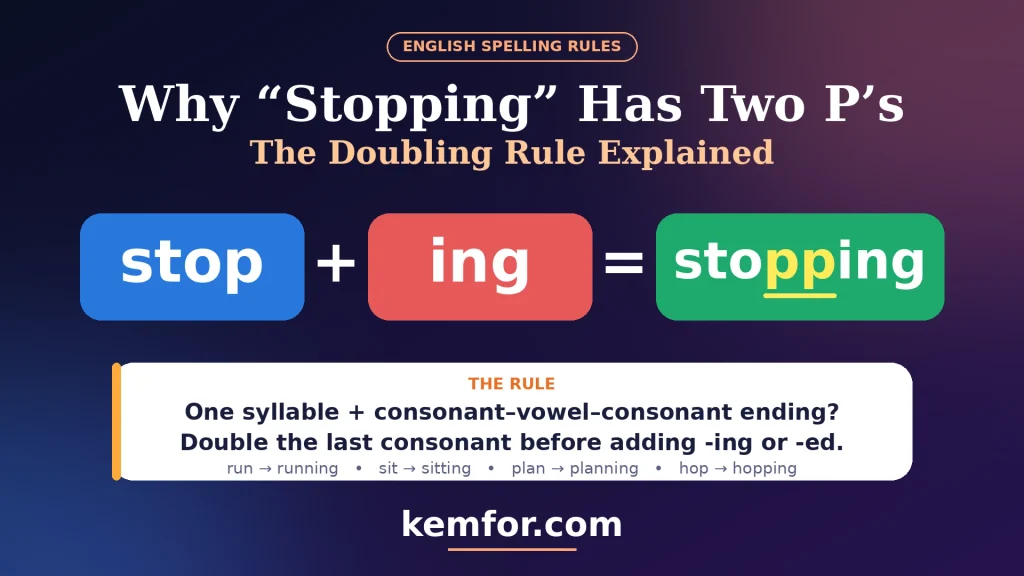
English spelling gets a bad reputation for chaos, but the doubled p in “stopping” is one of its more reliable habits. It is a rule with a purpose, and once you see the purpose, you rarely have to memorize anything.
The Consonant–Vowel–Consonant Pattern
Look at the base word: s-t-o-p. It ends in a single vowel followed by a single consonant, preceded by another consonant. Spelling teachers describe this as a consonant-vowel-consonant (CVC) ending. When a short word like this takes a suffix that begins with a vowel, such as -ing, -ed, or -er, the final consonant is doubled.
That is the same logic behind run → running, plan → planning, swim → swimming, and drop → dropping. The pattern is consistent enough that you can apply it to words you have never written before.
The Vowel Fence Check
The doubling is not decoration. It tells the reader how to pronounce the vowel. Two consonants after a vowel act like a fence that keeps the vowel short and sharp. Remove the fence and the vowel opens up and goes long.
You can see this by comparing pairs of words:
| Short vowel (doubled) | Long vowel (single) |
|---|---|
| hopping | hoping |
| tapping | taping |
| gripping | griping |
| mopping | moping |
| sitting | siting |
Every word on the right comes from a base word that ends in a silent e (hope, tape, gripe, mope, site). The e is dropped before -ing, and the single consonant that remains signals a long vowel. Every word on the left comes from a base word with no silent e, so the consonant doubles.
Here is the check in practice. Say “stop” in your head, then say “hop.” The vowels match, so “stop” belongs on the doubling side with “hopping.” If you wrote “stoping,” a reader would reasonably pronounce it to rhyme with “hoping,” which is not what you meant.
When the Doubling Rule Does Not Apply
Rules are only useful if you know their limits. Doubling does not happen in these cases:
- Words ending in w, x, or y. We write snowing, fixing, playing, never “snowwing” or “fixxing.”
- Words with two vowels before the final consonant. Read becomes reading, not “readding,” and boil becomes boiling.
- Words with two final consonants. Help becomes helping, and jump becomes jumping.
- Longer words where the stress is not on the last syllable. Open becomes opening, and visit becomes visiting. By contrast, words stressed on the final syllable do double: begin → beginning, commit → committing, occur → occurring.
“Stop” passes every test for doubling. It is short, it has one vowel, it ends in one consonant, and that consonant is not w, x, or y.
Where the Word “Stop” Comes From
The spelling has a history behind it. Old English had a verb, found in compounds such as forstoppian, that meant to plug or close something up. Etymologists trace it through West Germanic to a late Latin verb connected with stuffing a gap using tow, the coarse fibre left over from flax. The earliest picture behind the word is therefore a practical one: pushing material into a hole so nothing gets through.
From that physical image, the meaning spread. If you can stop up a bottle or a pipe, you can stop a flow, and from there you can stop a person, a vehicle, a rumour, or a habit. Over the following centuries the verb settled into its modern form, and the doubled consonant in stopping and stopped became fixed in print. It also survives in related words such as stopper, stoppage, and unstoppable.
Why So Many People Write “Stoping”
If the rule is this clear, why does the error persist? There are a few understandable reasons.
The silent-e habit. English has a huge family of verbs like hope, bake, rope, scope, and slope, all of which drop the e and take a single consonant: hoping, baking, roping, scoping, sloping. The brain pattern-matches “stop” to that family, especially when typing fast, and omits the second p.
Phonetic spelling. People often spell by ear. Because the two ps in “stopping” produce one p sound, the ear does not demand the extra letter.
The mining word’s existence. Some spell checkers and dictionaries recognize “stoping” as a valid technical term, so the error may not be flagged. A misspelling that is also a legitimate word is the hardest kind to catch.
Second-language transfer. Learners whose first language spells sounds more directly often find English doubling arbitrary at first. It becomes much less arbitrary once it is tied to vowel length, as described above.
Understanding the cause matters because it tells you where to look when proofreading. The mistake is not random; it clusters in -ing and -ed forms of short verbs.
What “Stoping” Actually Means in Mining
Now to the one place where “stoping” is the right spelling. In underground mining, a stope is the excavated void left behind when ore is removed from a deposit. The verb to stope means to extract ore in this way, and stoping is the process or the method.
The word is also genuinely a verb in its own right, which creates a detail that most spelling guides skip. Following the same pattern as scope → scoping, the verb stope gives stoping (present participle) and stoped (past tense). So “stoped” can be legitimate in mining prose, for instance when describing an area that has been “stoped out.” In general writing, though, “stoped” is still a misspelling of “stopped.”
Stope, Stoping, and Stoped in Context
- Noun: The geologists mapped the stope before reopening the level.
- Verb (participle): The crew has been stoping the upper section since spring.
- Verb (past): Much of the richest ground had already been stoped.
If you are writing for a general audience and need to mention the process, consider adding a short explanation of the term the first time it appears. Readers outside the industry will not know it.
The Main Stoping Methods
Mining engineers choose a method according to the shape of the orebody, the strength of the surrounding rock, and the economics of the operation. Four names come up often:
- Open stoping: ore is removed and the void is left open, relying on the strength of the surrounding rock to stay stable.
- Sublevel stoping: the ore is drilled and blasted from levels positioned between main haulage levels, then collected below.
- Shrinkage stoping: a portion of the broken ore is left in the stope temporarily so miners can stand on the pile and work upward.
- Cut-and-fill stoping: the ore is mined in horizontal slices, and the emptied space is filled with waste material or backfill before the next slice begins.
The choice among these affects safety, cost, and how much ore is recovered. For anyone writing about mining, this is where the word earns its keep. For everyone else, it is a useful reminder that a rare spelling can have a perfectly respectable home.
Pronouncing Stopping and Stoping
Sound is one of the most reliable ways to keep the two apart, because they do not sound alike.
Stopping uses a short o. In General American it is typically transcribed /ˈstɑːpɪŋ/, and in standard British English /ˈstɒpɪŋ/. It rhymes with “shopping” and “dropping.”
Stoping uses a long o. In American English it is /ˈstoʊpɪŋ/ and in British English /ˈstəʊpɪŋ/. It rhymes with “hoping” and “coping.”
This difference gives you a practical test for your own writing. Read the word aloud. If you hear “STOP-ing” with the same vowel as “stop,” you need the double p. If you meant the mining term, you would be saying “STOHP-ing,” and your sentence would be about ore.
Stopping in British and American English
Spelling differences between British and American English can make writers second-guess perfectly good words, so it is worth confirming that there is none here. Both varieties write stopping and stopped.
The regional split people have in mind involves words ending in l. British English tends to double the l before a suffix even when the final syllable is unstressed (travelling, cancelled, labelling), while American English usually does not (traveling, canceled, labeling). “Stop” is a stressed one-syllable word, so both varieties follow the standard rule and double the p.
If a style guide or a client asks you to localize a document between UK and US spelling, “stopping” never needs changing.
Every Form of the Verb Stop
Learning the full set of forms helps you see where the error tends to appear.
| Form | Name | Example |
|---|---|---|
| stop | base form | Please stop at the next exit. |
| stops | third person singular | The bus stops outside the library. |
| stopping | present participle / gerund | The bus is stopping now. |
| stopped | past tense / past participle | The bus stopped ten minutes ago. |
Related words follow the same doubling: stopper, stoppage, stopgap, stopwatch, nonstop, backstop, and unstoppable.
Stopped, Stoped, and the Archaic Stopt
The past form follows the same rule as the -ing form: stopped. The spelling “stoped” is a mistake in general English for the same reason “stoping” is. Older texts sometimes use “stopt,” a historical variant that has largely disappeared from modern usage. Unless you are quoting an older source, stay with “stopped.”
How “Stopping” Works in a Sentence
Spelling is only half of the job. Knowing the grammatical roles of the word helps you use it with confidence.
- Present participle in continuous tenses: The engine is stopping and starting.
- Gerund (acting as a noun): Stopping early saved the team a week of costs.
- Adjective or modifier: Stopping distance increases on wet roads.
- Noun component: The lay-by is a convenient stopping point.
The spelling stays the same in every role.
Stop Plus -ing Versus Stop Plus “To”
This is a distinction that trips up native speakers and learners alike, and it changes meaning completely.
- She stopped talking. She ceased the activity of talking.
- She stopped to talk. She paused something else in order to start a conversation.
When “stop” is followed by an -ing word, the second action ends. When it is followed by “to,” the second action is the purpose of the pause.
Phrasal Verbs with Stop
A good number of everyday expressions use “stopping”:
- I’m stopping by after work. (a short visit)
- We’re stopping over in Doha for a night. (a break in a journey)
- They’re stopping off at the market. (a brief detour)
In these, “stopping” does not mean ceasing, so synonyms like “quitting” do not fit. “Dropping in” or “visiting briefly” works better.
Stopping in Other Specialist Contexts
The word turns up in several technical and professional settings, and the spelling remains constant in all of them.
- Road safety: “Stopping distance” is the combined distance a vehicle covers while the driver reacts and the brakes bring it to rest. Highway codes in several countries publish typical figures to help drivers judge following gaps.
- Music: String players use “stopping” for pressing a string against the fingerboard to change its pitch. “Double stopping” means sounding two strings at once on an instrument such as the violin.
- Rail travel: In British usage, a “stopping train” calls at most or all stations on its route, in contrast to an express service.
- Entertainment: A “show-stopping” performance is one so impressive it interrupts the event, and it takes a hyphen when used as a modifier.
Notice that mining has “stoping,” but music has “stopping.” The two coexist in the language without overlapping.
Common Mistakes and How to Fix Them
These are the patterns that appear most often in drafts, emails, and published pages.
| Mistake | Correction | Reason |
|---|---|---|
| I’m stoping at the shop. | I’m stopping at the shop. | The participle needs the double p. |
| The rain stoped overnight. | The rain stopped overnight. | The past tense doubles the p. |
| We kept stoping to check. | We kept stopping to check. | Same rule after any helper verb. |
| Stoppping the leak | Stopping the leak | Three ps is a typing slip. |
| Stopin’ / stoppin | Stopping | Dropped g is acceptable only in deliberate informal dialogue. |
A word on the dropped g: you will see “stoppin’” in song lyrics, social media captions, and fictional dialogue. The apostrophe signals a deliberate imitation of casual speech. In professional or educational writing, spell out the full “stopping.”
Look-Alike Spelling Pairs Worth Knowing
The same short-versus-long vowel logic explains several other pairs that cause trouble. Learning them together reinforces the rule.
- hopping / hoping: a rabbit hops; a person hopes.
- tapping / taping: knocking on a door versus fixing a poster with tape.
- planning / planing: organizing an event versus smoothing wood.
- pinning / pining: fastening with a pin versus longing for someone.
- dinner / diner: the meal versus the person eating it or the restaurant.
- supper / super: an evening meal versus excellent.
- latter / later: the second of two things versus after a given time.
In each case, the double consonant protects a short vowel. When you find yourself unsure about any of them, reverse the logic: decide which vowel sound you intend, then spell it accordingly.
Practical Proofreading Habits That Catch This Error
Knowing the rule helps, but proofreading is where mistakes are actually prevented. A few habits work well.
- Search your own document. Before publishing, use Find to look for “stoping” and “stoped.” Unless your piece is about mining, every result is an error.
- Do not rely on spell check alone. Because the mining word is legitimate, some tools will not flag it. Treat automated checking as a first pass, not a final one.
- Read aloud or use text-to-speech. If you hear a long o where you meant a short one, the spelling is wrong.
- Proofread backwards. Reading sentence by sentence from the end of a document breaks the flow that lets your brain autocomplete mistakes.
- Create a personal watch list. If you know you tend to mistype certain words, keep them in a short list and search for them every time.
For web publishers, there is an additional reason to be careful. A misspelling in a heading, title tag, or meta description is visible to every visitor and to anyone scanning search results, and it can quietly weaken a page’s credibility.
A Quick Self-Test
Choose the correct word in each sentence. The answers follow.
- The bus keeps (stopping / stoping) at every corner.
- The miners are (stopping / stoping) the lower orebody this quarter.
- She (stopped / stoped) mid-sentence when the phone rang.
- We are (stopping / stoping) by your office on Friday.
- (Stopping / Stoping) the machine mid-cycle can damage the motor.
Answers: 1. stopping. 2. stoping (mining context). 3. stopped. 4. stopping. 5. stopping.
If you got the second one wrong, that is useful information too. It means you correctly learned the rule and then met the exception, which is the best way to remember both.
Conclusion
The question of stopping or stoping comes down to one principle: short vowels are protected by doubled consonants. “Stop” has a short o, so it becomes stopping and stopped. “Stoping” belongs to the specialized vocabulary of underground mining, where it names a genuine and important process.
Keep three things in mind. First, say the word aloud and listen for the vowel. Second, remember that silent-e verbs like hope and scope are what produce the single-p look. Third, search your finished work for the two usual culprits before anyone else sees it. With those habits in place, this particular error stops being a worry.
Frequently Asked Questions
Is “stoping” a real word?
Yes, but only in mining and related technical fields, where it refers to extracting ore and leaving a void called a stope. In general writing, “stoping” is a misspelling of “stopping.”
How do you spell the -ing form of stop?
It is spelled S-T-O-P-P-I-N-G. The final consonant of “stop” doubles before the -ing ending.
Why does “stop” double the p before -ing?
Because “stop” is a short word ending in a single vowel followed by a single consonant. English doubles the consonant in that situation to keep the vowel short.
Is it “stopped” or “stoped”?
The correct past tense is stopped. “Stoped” is only valid as the past tense of the mining verb stope, which is rarely relevant outside technical writing.
How do you pronounce “stoping”?
It is pronounced “STOHP-ing,” with a long o that rhymes with “hoping.” “Stopping” has a short o and rhymes with “shopping.”
Do British and American English spell “stopping” differently?
No. Both varieties use “stopping” and “stopped.” The usual UK-US differences involve words like travelling/traveling and cancelled/canceled, not “stop.”
What is the difference between “stopping by” and “stopping”?
“Stopping” on its own usually means ceasing or pausing. “Stopping by” is a phrasal verb meaning to visit briefly. The spelling is identical, but the meaning is closer to “dropping in.”
What are some synonyms for stopping?
Depending on context: ceasing, halting, pausing, ending, discontinuing, blocking, preventing, or braking. For “stopping by,” try dropping in or visiting briefly.