Type “goverment” into a search bar and you are in good company. Millions of people have dropped that silent letter at some point, and search engines have learned to quietly correct it. But the misspelling is only the doorway. Behind it sits one of the most consequential ideas humans have ever built: an organized system for making collective decisions, settling disputes, and sharing resources among people who will never all agree.
This guide does two jobs. First, it settles the spelling question and gives you a way to remember it. Second, it explains what government is, where the idea comes from, what governments do, how they are structured, and why the differences between systems matter to your daily life. Whether you are a student, a writer, a voter, or someone who simply wants clarity, you will find practical explanations here rather than textbook recitation.
Government or Goverment: Which Spelling Is Correct?
The correct spelling is government, with an “n” in the middle. “Goverment” is not an accepted variant in American, British, Canadian, Australian, or any other standard form of English. It is simply a typo that has become common enough to be recognizable.
The word is built from two parts: the verb govern and the suffix -ment. Since the verb already ends in “n,” the full word keeps it: govern + ment = government. Remove that “n” and the word no longer maps onto the verb it came from.
Why the “N” Gets Skipped
There is a plausible reason this error is so persistent. In fast, natural speech, many people pronounce the word as “GUV-ment” or “GUV-er-ment,” and the “n” sound is soft or nearly absorbed by the neighboring consonants. When we spell from sound rather than from structure, the letter vanishes.
The same thing happens with other words that carry a swallowed consonant, such as “environment” (often typed “enviroment”) and “February” (often written “Febuary”). The pattern is consistent: when a sound is lightly pronounced, writers drop the letter that represents it.
A Quick Memory Trick
Remember that you govern first, then you have government. If you can spell govern, you already have the “n.” Another approach is to think of the word as “govern” followed by “ment,” and say it that way in your head while typing a few times. Within a week or two the correct form usually becomes automatic.
What Is Government? A Working Definition
In the simplest terms, a government is the group of people and institutions that holds recognized authority to make rules, enforce them, and manage the shared affairs of a political community. That community might be a city, a province, a nation, or, in the case of bodies such as the European Union, a union of nations with pooled powers.
A useful way to understand the concept is through a question: who decides, and what gives them the right to decide? Every government is an answer to that question. Some answer it with elections, some with inheritance, some with religious doctrine, and some with force. The answer shapes everything that follows, from how taxes are set to whether a citizen can criticize leaders publicly.
The sociologist Max Weber offered one of the most cited ideas in this area: that the state claims a monopoly on the legitimate use of physical force within a territory. You do not have to adopt that view completely to see its value. It explains why a government can arrest someone, but a private neighbor cannot, and it highlights that legitimacy, not just power, is the heart of the matter.
Where the Word Government Comes From
The word reached English through Old French, which inherited it from Latin gubernare, meaning to steer or direct a ship. The Latin term itself traces back to the Greek kybernan, with the same nautical sense. This is also why the word cybernetics shares that root.
The metaphor is revealing. A government, in its original conception, is a steering mechanism. It does not propel the ship; the people and the economy do that. Its job is to keep the vessel on course, avoid hazards, and prevent it from drifting into chaos. When governments forget the steering role and try to become the engine, or when they stop steering altogether, problems tend to follow.
The Core Functions of Government
Governments vary enormously, but almost all of them, regardless of ideology, perform a recognizable set of tasks.
Maintaining Order and National Security
The oldest function of government is protection. This covers policing, criminal justice, border control, and national defense. Without a reliable authority to prevent violence and theft, people must spend most of their energy defending themselves, which leaves little room for farming, trade, education, or invention.
Making and Enforcing Laws
A government creates the rules under which people live, and it must also ensure those rules are followed. A law that is never enforced is merely a suggestion, and a law enforced selectively erodes public trust. The quality of a legal system is often judged less by the rules on paper than by how evenly they are applied to the powerful and the powerless alike.
Providing Public Goods and Services
Some things are valuable to everyone but hard for a private company to supply profitably: roads, street lighting, clean water systems, public health surveillance, and basic research. Economists call these public goods. Governments step in because the market alone tends to underproduce them. Many governments also run schools, hospitals, and social insurance programs, though how much they do varies widely from country to country.
Managing the Economy
Governments collect taxes, set budgets, regulate industries, and, through a central bank or similar institution, influence money and interest rates. They also set the legal framework for contracts, property, and business competition. Debates about how much the state should intervene in the economy sit at the center of most national political arguments.
Protecting Rights and Resolving Disputes
Courts exist so that conflicts can be resolved by rules rather than by strength. A functioning justice system lets a small business owner challenge a large company, or a citizen challenge the state itself. Where this function is weak, people are left without recourse, and informal power tends to fill the gap.
The Three Branches: How Power Is Divided
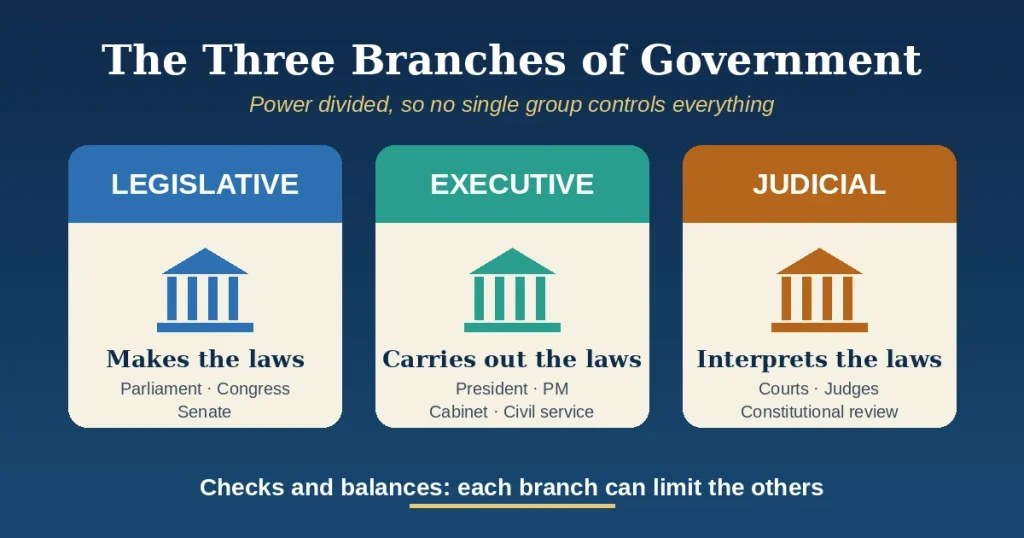
Many modern governments divide authority among three branches. This idea is closely associated with the French philosopher Montesquieu, who argued in the eighteenth century that concentrating all power in one place invites abuse.
The Legislative Branch
The legislature writes laws, approves budgets, and often oversees the executive. It may be called a parliament, congress, national assembly, or senate, depending on the country. Its members are typically elected, although some systems include appointed or hereditary seats.
The Executive Branch
The executive carries out the law and runs the day-to-day machinery of the state. It includes the head of state or head of government, ministers or cabinet members, and the civil service. In practice, this is the branch citizens interact with most: issuing passports, collecting taxes, running public agencies.
The Judicial Branch
Courts interpret the law and decide cases. In systems with a written constitution, higher courts often have the power to review whether laws or government actions comply with it. Judicial independence, meaning judges can rule without fear of punishment from other branches, is widely treated as a basic indicator of a healthy system.
The key idea behind this division is checks and balances: each branch can limit the others, so no single group can act without resistance. It does not guarantee good government, but it raises the cost of abuse.
The Main Types of Government
Political scientists classify governments in several ways. One of the clearest is by asking who holds power and how they obtain it. Real countries rarely fit a single category perfectly, but the categories help make sense of the landscape.
Democracy
In a democracy, authority ultimately rests with the people, exercised either directly or through elected representatives. Most modern democracies are representative. Citizens vote for lawmakers or leaders, who then govern on their behalf. Healthy democracies depend on more than elections; they also need free speech, independent courts, a free press, and protections for minorities.
Monarchy
A monarchy is led by a king, queen, emperor, or similar figure, usually through hereditary succession. Monarchies differ sharply. In an absolute monarchy, such as Saudi Arabia, the ruler holds broad decision-making power. In a constitutional monarchy, such as the United Kingdom, Japan, or Sweden, the monarch’s role is largely ceremonial and real authority lies with elected officials.
Republic
A republic is a system in which the head of state is not a hereditary monarch, and in which public office is understood as a public trust. The term is often combined with democracy, as in the United States, India, and Pakistan, though some states have called themselves republics without being meaningfully democratic.
Oligarchy
Here, power sits with a small group, defined by wealth, military control, family ties, or party membership. Oligarchies can exist inside systems that appear democratic on paper, which is why analysts look at who actually influences decisions, not only at who holds formal titles.
Authoritarian and Totalitarian Systems
In an authoritarian system, power is concentrated in a leader or ruling party with limited accountability, and political opposition is restricted. Totalitarian systems go further by seeking control over nearly every aspect of public and private life. Such governments often rely on censorship, surveillance, and tight control of information.
Theocracy
In a theocracy, religious law or religious authority forms the basis of government. Vatican City is a commonly cited example, and Iran combines elected institutions with a system of clerical oversight, which is why scholars often describe it as a hybrid.
Unitary, Federal, and Confederal Systems
Another way to compare governments is by how power is distributed across territory.
Unitary states keep ultimate authority at the national level. Local governments exist, but they operate with powers granted by the central government. France and Japan are frequently cited examples.
Federal states divide authority between a national government and regional governments, and the division is protected by the constitution. The United States, Germany, India, Canada, and Pakistan, with its provinces, are federal systems. Federalism lets regions adapt policies to local needs, but it can also produce overlap and disputes about who is responsible for what.
Confederations are looser arrangements in which member states retain most of their authority and the central body has limited powers. They are rare today and tend to be unstable over time.
Parliamentary vs. Presidential Systems
Among democracies, one major design choice concerns the relationship between the legislature and the executive.
In a parliamentary system, the government is formed from the legislature. The prime minister usually leads the party or coalition that commands a majority, and the government can fall if it loses the confidence of parliament. This tends to produce smoother cooperation between lawmakers and the executive, but it can concentrate power when one party holds a large majority.
In a presidential system, the president is elected separately from the legislature and serves a fixed term. This creates a clearer separation of powers, but it can also produce deadlock when the president and the legislature are controlled by opposing parties.
Neither model is universally better. The outcomes depend heavily on political culture, party systems, and the strength of institutions.
How Governments Are Funded
Governments do not generate wealth by themselves. They draw resources from the economy, mainly through taxation. Common sources include income taxes, taxes on goods and services, corporate taxes, customs duties, and property taxes. Some countries also rely heavily on revenue from natural resources or state-owned enterprises.
When spending exceeds revenue, governments borrow by issuing bonds, which creates public debt. Debt is not inherently harmful; it can finance long-term infrastructure or help during emergencies. The concern arises when borrowing grows faster than a country’s ability to repay, since rising interest costs can crowd out spending on health, education, and development.
A practical habit for any citizen is to look at a budget the way you would look at a household’s finances: where does the money come from, where does it go, and which priorities does the pattern reveal? A budget is a statement of values expressed in numbers.
Government and Citizens: Rights and Responsibilities
The relationship between government and citizens runs in both directions. Governments owe people protection, fair treatment, and reasonable services. Citizens, in turn, are generally expected to obey the law, pay taxes, and, in democracies, take part in civic life.
Rights are typically grouped into a few broad families: civil rights, such as equality before the law; political rights, such as voting and assembling; and social or economic rights, such as access to education or healthcare, which different countries recognize to different degrees. The existence of a right on paper means little unless there are institutions able and willing to defend it.
How to Evaluate Whether a Government Is Working Well
Labels like “democracy” or “republic” tell you less than you might expect. A more useful approach is to look at observable signs of performance:
- Rule of law: Are laws applied consistently, including to officials?
- Accountability: Can citizens remove leaders and scrutinize decisions without fear?
- Transparency: Is information about budgets and policy decisions accessible?
- Service delivery: Do schools, courts, and utilities function reliably?
- Institutional stability: Do rules remain predictable from one administration to the next?
Several independent organizations publish indices on governance, corruption, and political freedom, and reading those reports alongside local news gives a more rounded picture than any single headline.
Common Misconceptions About Government
“Government and state are the same thing.” They are related but distinct. The state is the lasting structure of territory, institutions, and law. The government is the specific group of people running it at a given time. Governments change; the state continues.
“Bigger government always means more control.” Size and control are not identical. A small government can be highly repressive, and a large one can be highly accountable. What matters is how power is checked, not just how much money is spent.
“Democracy means majority always wins.” Mature democracies protect individual and minority rights even when a majority might prefer otherwise. Majority rule without those protections can become tyranny of the majority.
“Voting is the only way to participate.” Elections matter, but so do public consultations, local meetings, petitions, community organizing, and informed engagement with the media.
Challenges Facing Modern Governments
Today’s governments operate under pressures their predecessors rarely faced. Digital technology has changed how information spreads and how elections are contested, and it has raised difficult questions about privacy and misinformation. Climate change and pandemics are problems that cross borders and require coordination beyond any one state. Aging populations strain pension and healthcare systems in many countries, while rapid population growth creates different pressures elsewhere.
There is also the persistent challenge of public trust. When citizens believe institutions are corrupt or unresponsive, compliance drops and polarization grows. Rebuilding trust usually requires visible results and honest communication, not slogans.
Conclusion
The spelling question has a simple answer: it is government, not “goverment,” and remembering that you govern before you have government keeps the “n” where it belongs.
The larger question is more interesting. Government is a steering mechanism for human society, imperfect by nature and shaped by the people who build and operate it. Understanding its functions, branches, types, and funding does more than help with exams or essays. It helps you read the news with sharper judgment, ask better questions of those in office, and recognize when institutions are doing their job and when they are not. A well-informed public remains one of the most reliable safeguards any political system has.
Frequently Asked Questions (FAQ)
Is it “government” or “goverment”?
The correct spelling is “government.” “Goverment” is a common misspelling that omits the “n” found in the root verb “govern.”
What is the simplest definition of government?
A government is the system and group of people with recognized authority to make laws, enforce them, and manage the shared affairs of a country, region, or community.
What are the main functions of government?
The primary functions include maintaining security and order, creating and enforcing laws, providing public services and infrastructure, managing economic policy, and protecting rights through a justice system.
What are the three branches of government?
The legislative branch makes laws, the executive branch carries them out, and the judicial branch interprets them and resolves legal disputes. Dividing power this way helps prevent any single body from dominating.
What is the difference between a government and a state?
The state is the lasting political structure that includes territory, population, and institutions. The government is the temporary group of officials who run those institutions. Governments change after elections or political shifts, while the state endures.
What are the most common types of government?
Common types include democracy, monarchy, republic, oligarchy, authoritarian rule, and theocracy. Many real-world systems blend features from more than one category.
What is the difference between federal and unitary government?
In a federal system, power is constitutionally divided between national and regional governments. In a unitary system, ultimate authority rests with the national government, which may delegate powers to local bodies.
How is a parliamentary system different from a presidential one?
In a parliamentary system, the executive emerges from the legislature and depends on its confidence. In a presidential system, the president is elected separately and holds a fixed term, creating a stricter separation between branches.
How do governments raise money?
Mainly through taxes on income, consumption, property, and corporate profits, supplemented by fees, customs duties, resource revenues, and borrowing.
How can ordinary citizens influence government?
Citizens can vote, contact elected representatives, attend public hearings, join civic organizations, sign petitions, follow budgets and policy debates, and support independent journalism that holds officials accountable.