You are halfway through an email, a résumé, or a school essay, and you stop. You typed a word, and something looks off. Is it independent or independant? Both versions look plausible, and your eyes can talk themselves into either one.
This is one of the most common spelling doubts in English, and it deserves a proper answer rather than a one-line correction. Below you will find the verdict, the reasoning behind it, the pattern that causes the confusion, reliable ways to remember the right form, and practical guidance on using the word correctly in professional, academic, and everyday writing.
The Quick Answer: “Independent” Is the Only Correct Spelling
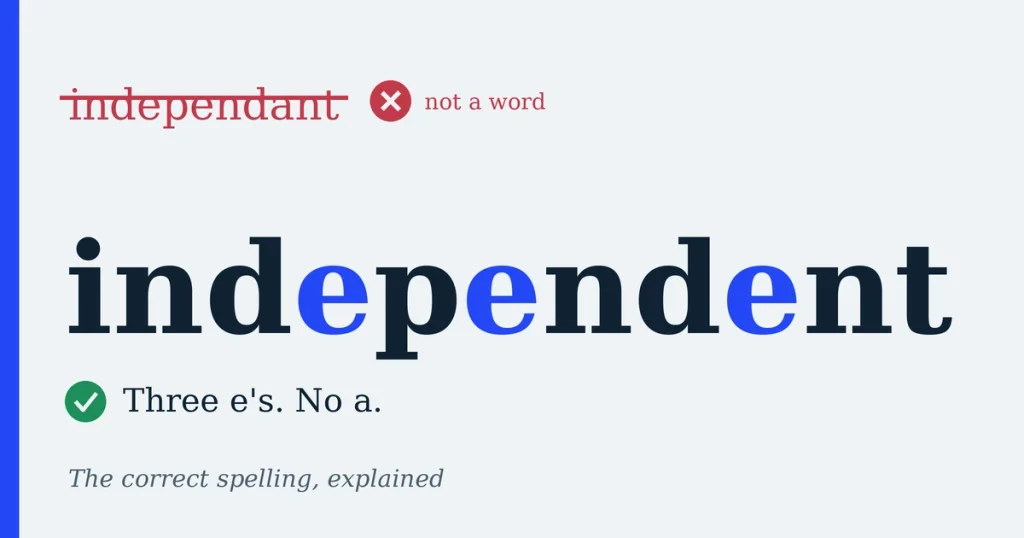
Independent is the correct spelling. It ends in -ent, not -ant.
“Independant” is not an accepted variant in American English, British English, Canadian English, or Australian English. No major dictionary lists it as an alternative form. It is simply a misspelling, and spellcheckers will flag it every time.
If you only needed the answer, you can stop here. If you want to understand why the mistake is so common, and never second-guess yourself again, keep reading.
Why “Independant” Looks Right but Isn’t
A misspelling this common is rarely a sign of carelessness. It usually points to a real quirk in how English works. Two forces combine to make “independant” feel believable.
The -ent and -ant Suffix Problem
English has a large family of words ending in -ant and another large family ending in -ent. Many of them describe a person or a quality, and they are easy to mix up:
- assistant, tenant, servant, pleasant, important, distant (all -ant)
- student, innocent, different, present, excellent, patient (all -ent)
Nothing in the meaning of a word tells you which ending it takes. The choice is largely a historical accident inherited from Latin and French, so your memory has to do the work, and memory is fallible when the two endings are so similar.
The Sound Problem
In everyday speech, the final syllable of independent is unstressed. Speakers reduce the vowel to a soft, neutral sound often called a schwa. That sound is nearly identical whether the letter underneath is an e or an a. When you say the word aloud, your ears give you no clue.
So you are left with two weak signals: a sound that cannot help and a visual memory that may have been shaped by seeing the wrong spelling online. The result is hesitation, even among confident writers.
Where the Word Comes From
Understanding a word’s origin often makes its spelling stick. Independent is built from two parts. The prefix in- means “not.” The base, dependent, comes from the Latin verb dependere, which means “to hang down from” or “to hang from something.”
The image underneath is a useful one. Something dependent hangs from something else and relies on it for support. Something independent does not. It stands on its own.
The word entered English in the early 1600s, and its core idea has stayed stable ever since: not relying on, controlled by, or connected to something else for support.
Because independent is just dependent with a prefix, the spelling question reduces to a simpler one. How is dependent spelled? Which brings us to a related source of confusion.
The Dependent/Dependant Distinction and Why It Muddies Things
Part of the reason “independant” survives is that its root word has a legitimate twin.
Dependent vs. Dependant
In British English, two spellings of the root exist, and they do different jobs:
- Dependent (with -ent) is the adjective. It describes reliance: “The outcome is dependent on funding.”
- Dependant (with -ant) is a noun for a person who relies on another, usually financially: “She claimed tax relief for each of her dependants.”
In American English, dependent is generally used for both the adjective and the noun, and dependant is rare or considered a British-style variant.
This distinction is the source of the trap. A writer who has seen “dependant” in an official British form may reasonably assume that independent might also have an “-ant” version. It does not. Independent has no noun-for-a-person form in the same way, and its spelling is fixed.
Other Tricky Pairs Worth Knowing
English has several look-alike pairs where one letter changes the word’s role or meaning:
- Resistant / resistent: only resistant is standard.
- Confident / confidant: confident means sure of yourself; confidant is a person you trust with secrets.
- Defendant: always -ant.
- Persistent: always -ent.
Noticing how arbitrary these endings are can reassure you. The confusion you feel around independent is shared by millions of writers, and it is learnable.
Simple Memory Tricks That Actually Work
Rules of thumb about -ant and -ent have too many exceptions to be reliable. Concrete, physical memory aids work better. Here are three that hold up.
Look for the Hidden Words
Inside independent you can find small, familiar words. The letters spell out “in” + “depend” + “ent”, and the middle chunk, depend, is a word you already know how to spell. If you can spell depend, you can build the rest. Notice also that pen sits in the middle of the word, a tiny anchor for the correct middle sequence.
Count the E’s
The word independent contains exactly three e’s and no a’s at all: in-dep-end-ent. If you write the word and count fewer than three e’s, something went wrong. A quick scan for the letter a is an even faster test. There should not be one.
Break It Into Chunks
Syllable chunking turns an eleven-letter word into four easy pieces:
in – de – pen – dent
Say each chunk slowly while typing or writing it. The final chunk, dent, matches the word dent, as in a small dent in a car door. Think “dent,” not “dant.” That small image is surprisingly effective, because dant is not a word, while dent is.
How “Independent” Works Grammatically
Once the spelling is secure, it helps to know how the word behaves in a sentence. It serves mainly as an adjective, but it also appears as a noun.
As an Adjective
As an adjective, independent describes something that is free from outside control, influence, or support. Examples:
- “She built an independent consulting practice after leaving the agency.”
- “The review was carried out by an independent panel.”
- “Toddlers become increasingly independent between ages two and three.”
In each case, the word signals separation: from a boss, from a funder, from a parent, or from another variable.
As a Noun
Independent can also name a person or entity. In politics, an independent is a candidate or voter who is not formally aligned with a party. In the entertainment and publishing worlds, people often shorten “independent film” or “independent record label” to “an indie” or even “an independent.”
When used as a noun, the spelling does not change. It is still independent, and the plural is simply independents.
“Independent” in Real-World Contexts
The word turns up in many fields, and its precise meaning shifts slightly in each. Knowing these usages helps you write with accuracy as well as correct spelling.
Independent Contractor and Freelance Work
In employment, an independent contractor is a person who provides services to a client without being a regular employee. In the United States, tax authorities generally look at the degree of behavioral control, financial control, and the nature of the relationship to decide whether a worker is truly independent or should be treated as an employee. Because classification has legal and tax consequences, the term matters, and so does spelling it correctly in contracts and invoices.
Politics and Elections
An independent voter or candidate does not belong to a major political party. The word is used the same way in many countries, though the practical meaning varies with the electoral system. In some systems independents run on their own ballot line; in others they may caucus with a party while keeping the label.
Grammar and Language
In grammar, an independent clause contains a subject and a verb and can stand alone as a complete sentence: “The meeting ended.” A dependent clause cannot stand alone: “Because the meeting ended.” The terms mirror the word’s meaning exactly. Independent clauses do not rely on anything else to make sense.
Science and Statistics
In experiments, the independent variable is the factor a researcher deliberately changes to see its effect. The dependent variable is what gets measured as a result. If you are writing a lab report, getting both terms spelled correctly is part of looking credible.
Business, Media, and Music
Independent also describes small, self-funded, or owner-run organizations: independent bookshops, independent publishers, independent labels, independent pharmacies. In these settings the word often carries a sense of craft and local identity, and it appears in business names and marketing copy. A misspelling here is especially costly, because it sits on signs, websites, and packaging.
Related Word Forms and Their Common Misspellings
The root of the problem often spreads to related words. If you master the family, you protect yourself across all of them.
- Independence (noun): the state of being independent. A common error is “independance.” The correct ending is -ence.
- Independently (adverb): “The two teams worked independently.” The common error is “independantly.”
- Interdependent (adjective): mutually reliant. Note the same -ent ending.
- Independents (plural noun): people or organizations that are independent.
A helpful consistency check: every correct form in this family uses -ent or -ence. If you ever see an a in the middle of the ending, it is wrong.
Independent vs. Similar Words: Choosing the Right Term
Sometimes the better fix is not the spelling but the word itself. Independent is broad, and close alternatives carry slightly different shades of meaning.
- Autonomous emphasizes self-governance, often used for regions, institutions, or systems: “an autonomous department.”
- Self-reliant stresses a person’s ability to meet their own needs: “a self-reliant traveler.”
- Self-sufficient focuses on producing or providing everything needed without outside help.
- Freelance applies to people who work for themselves rather than a single employer.
- Impartial or unbiased is often the better choice when you mean “free from conflicts of interest,” as in a review or audit.
If you describe a report as “independent,” readers expect it to be free from influence by the party being assessed. If you mean something narrower, a more specific word may serve you better and read as more precise.
Practical Tips for Writers, Students, and Professionals
A few habits will keep this error out of your work permanently.
Do not rely on autocorrect alone. Most tools catch “independant,” but they may fail inside names, URLs, image file names, or text pasted from a design file. Proofread those separately.
Search your document before publishing. A quick “find” for “-ant” endings in a long document can catch the wrong form if you tend to make this slip. Searching for “independan” will find every instance in seconds.
Check brand and product names. Some companies use intentionally unusual spellings. If you are writing about an organization, confirm its exact name, because the standard dictionary form may not apply to a trademark.
Slow down on high-stakes text. Cover letters, legal documents, grant applications, and web headlines deserve a deliberate second read. Spelling errors in these places are noticed more than anywhere else.
Teach the memory aid to others. If you manage a team or tutor students, sharing the “three e’s, no a” trick takes ten seconds and prevents a recurring error.
Why Getting This Spelling Right Matters
A single misspelled word rarely ruins a document, but it does shape impressions. Readers tend to treat spelling as a quick proxy for care. In a job application, a typo in a word as basic as independent, which appears constantly in phrases like “I work independently,” can undercut the very quality you are claiming.
The same applies to websites and published content. Search engines are good at recognizing misspellings and often show results for the correct term anyway, but on-page errors still reduce trust with human readers. For anyone producing content, whether a blog, a product page, or a company profile, consistency and accuracy signal editorial standards.
There is also a practical benefit in avoiding the problem altogether. A reader who spots a spelling mistake in the first paragraph may stop reading closely, and your actual message gets less attention than it deserves.
Frequently Asked Questions
Is it “independent” or “independant”?
It is independent. The spelling “independant” is incorrect in all major varieties of English and is not listed as an acceptable alternative in standard dictionaries.
Is “independant” ever correct in British English?
No. British English does use dependant as a noun for a person who relies on someone else for financial support, but there is no equivalent “independant.” The British spelling of the word is the same as the American one: independent.
Why do so many people spell it “independant”?
Two reasons stand out. First, the unstressed final syllable sounds almost identical whether it is spelled with e or a. Second, English has many words ending in -ant, and the existence of the noun dependant in British English makes the wrong form feel plausible.
What is the easiest way to remember the correct spelling?
Remember that the word contains three e’s and no a, and think of the chunk “dent,” not “dant,” at the end. You can also remember that it is simply “in” plus “dependent.”
How do you spell the noun form, “independence”?
The noun is spelled independence, ending in -ence. “Independance” is a common misspelling and is incorrect.
What is the difference between “dependent” and “dependant”?
In British English, dependent is the adjective (relying on something) and dependant is a noun for a person who relies on someone else. In American English, dependent is used for both roles. Neither spelling changes the correct form of independent.
Is “independent” used as a noun?
Yes. It can refer to a person or organization that is not tied to a larger group, such as a voter who does not belong to a political party or a small, self-owned business. The spelling stays the same, and the plural is independents.
Does Google treat “independant” the same as “independent”?
Search engines generally recognize the misspelling and often return results for the correct term, sometimes with a “showing results for” note. That does not make the misspelling acceptable in your own writing, since readers judge the text on the page.
Conclusion: One Word, One Spelling
The question “independent or independant?” has a short answer and a satisfying explanation. Independent is correct, and independant is a misspelling that has persisted because English endings are inconsistent and the final syllable sounds the same either way.