You are halfway through an email, a cover letter, or a school essay, and you reach a word you have typed a hundred times. Your fingers hesitate. Is it foreign or foriegn? The two look almost identical, the squiggly red underline may or may not be helping, and a tiny doubt creeps in.
The answer is simple, and the reasons behind it are more interesting than most people expect. The correct spelling is “foreign.” “Foriegn” is a misspelling, and one of the most common ones in the English language. It survives because it follows a rule almost every English speaker learns in childhood, and that rule happens to fail here.
This guide settles the question quickly, then goes further. You will see why the mistake is so tempting, where the word actually came from, which other words behave the same way, and a handful of memory aids that work better than repeating a rhyme. You will also find practical notes on how the word is used in law, finance, medicine, and technology, and how to choose respectful language when the word is applied to people.
The Short Answer: “Foreign” Is Correct and “Foriegn” Is Not
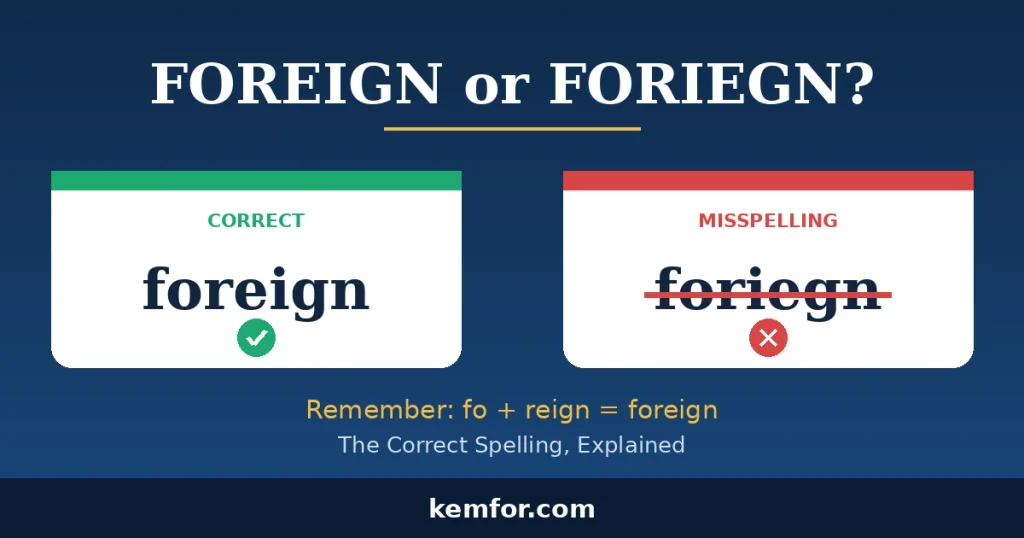
The spelling is F-O-R-E-I-G-N. The vowel pair in the middle is e followed by i, not the other way around. Every standard dictionary lists “foreign” and nothing else. There is no regional variant, no older accepted form, and no alternative used in British, American, Canadian, or Australian English.
If you want the fastest possible fix, remember this: take the word “reign” and put “fo” in front of it. Fo + reign = foreign. We will come back to that trick in detail, but it is the single most reliable shortcut, and it works because the ending of the word really is “reign” in disguise.
Search engines understand the confusion. Someone who types the misspelled version into a search box will usually see results for the correct word, which is convenient for readers but also a gentle reminder that the error is common enough to be anticipated.
Why So Many People Type “Foriegn”
Misspellings are rarely random. They tend to have causes, and understanding the cause is the best way to stop repeating the error. Three forces work together on this particular word.
The Pull of “I Before E”
Most English learners absorb the guideline “i before e, except after c.” It is useful for words like believe, niece, field, and achieve. Once a pattern like that is stored in memory, the brain applies it automatically, often without checking. When you meet foreign, your memory offers the familiar “ie” arrangement, and your fingers follow.
The guideline is also incomplete, which is part of the problem. The fuller version includes “or when sounding like ‘ay,’ as in neighbor and weigh,” and even that leaves a long list of exceptions. Foreign belongs to that list.
Silent Letters and a Muffled Middle
Say the word aloud at normal speed. In most accents, the second syllable is reduced to a weak “in” or “un” sound. You do not hear a clear “e” or a clear “i,” and you certainly do not hear the “g.” When the ear provides no clue about which vowel comes first, the writer has to rely on memory alone, and memory defaults to the more common pattern.
Keyboard Fingers and Transposition
There is also a mechanical cause. Typists frequently swap adjacent letters, particularly when those letters are typed by different hands or in quick succession. “Ei” becoming “ie” is one of the classic transposition slips. Even writers who know the correct spelling will occasionally type the wrong one when typing fast, which is why proofreading matters even for confident spellers.
Where the Word Foreign Comes From
The history of a word often explains its strange spelling, and foreign is a good example. It entered English during the Middle Ages through Old French, where forms such as forain meant something external, strange, or from outside. The French word traces back to Late Latin foraneus, meaning “on the outside,” which in turn comes from the Latin adverb foras, meaning “outdoors” or “out of doors.”
That Latin root is connected to the idea of a door or threshold: what lies outside the doorway. The same family of ideas lies behind several other English words, and many etymologists also link the word forest to this notion of the wild land beyond cultivated or enclosed space. The core meaning has barely changed over the centuries. A foreign thing is something that sits outside your own house, village, nation, or system.
Middle English writers spelled the word in many ways, including forms like forein and foreyne. The spelling was not standardized, and different scribes wrote what they heard. Modern spelling arrived later, shaped by printing and by habits borrowed from other words.
Why the “G” Is There at All
The silent “g” is the oddest feature of the modern word, and it was not part of the original. Early forms ended without it. The letter appeared in English spelling around the sixteenth century, and the most widely accepted explanation is that writers modeled the word on reign, a word that does carry a silent “g” and that came into English from Latin through French.
The same thing happened to sovereign, which also picked up an unjustified “g” through association with reign, even though the two words are not related in origin. In other words, the spelling we use today reflects a well-meaning but historically mistaken analogy.
This is useful to know for two reasons. First, it explains why the ending of foreign looks like reign. Second, it gives you a built-in memory tool, which we will use shortly.
Foreign Is Not Alone: Other Words That Break the Rule
It helps to realize that foreign sits in good company. English has dozens of words where “ei” appears and the neat guideline does not apply. The most relevant group is the set of words where “ei” produces a short, weak “i” sound, just as it does in foreign:
- forfeit: to give up something as a penalty
- counterfeit: a fake copy, especially of money
- surfeit: an excessive amount
- sovereign: a supreme ruler, or something that is self-governing
Notice the pattern. In each of these, the “ei” sits inside an unstressed syllable and sounds like a plain “i.” If you learn the whole family together, you are far more likely to remember that foreign belongs with them than if you try to memorize it as a solitary oddity.
Other common “ei” words that defy the guideline for different reasons include weird, seize, either, neither, leisure, protein, caffeine, and height. And there are the reverse cases, such as science, ancient, and species, where “ie” follows a “c.” English spelling is full of such exceptions, which is exactly why mechanical rules are a weak foundation and memory aids tied to specific words are stronger.
Memory Tricks That Actually Work
Rhymes are fine, but the best spelling aids are specific, visual, and tied to the exact word. Here are three that tend to stick.
Build It From “Reign”
Write the word reign. Now add “fo” at the front. You get foreign. This works because the last five letters really are r-e-i-g-n in the same order. When you doubt the spelling, picture a monarch’s reign with two extra letters attached. Since reign has “ei” and never “ie,” your brain has an anchor.
Group It With Its Family
Create a mental folder labeled “short-i ei words” and put foreign, forfeit, counterfeit, and sovereign inside it. When you hesitate, you retrieve the folder instead of re-deriving the spelling. Studies of spelling instruction generally support teaching words in related groups, because grouping gives the memory more hooks.
Write It Out on Purpose
Typing and autocorrect have made handwriting less common, but physically writing a tricky word three or four times, slowly, builds a motor memory that typing does not. Try writing foreign with the letters “eig” slightly spaced, like f-o-r-e-i-g-n, so the tail end is visually grouped. It is a small exercise, and for many people it is enough to fix the habit permanently.
How to Pronounce Foreign
Pronunciation causes its own confusion, because the spelling and the sound do not match closely. In American English, the word is commonly pronounced “FOR-in” or “FAR-in,” depending on region. In British English, it is typically closer to “FOR-un,” with a short first vowel. In every major accent, the second syllable is weak and unstressed, and the “g” is silent.
That silent “g” deserves special mention for learners of English. It is not pronounced in foreign, reign, sovereign, campaign, or design. If you are speaking, do not add a “g” sound. If you are writing, do not leave the letter out. The word is also a reminder that English pronunciation is not a reliable guide to spelling, which is something native and non-native speakers both discover the hard way.
Common Misspellings of Foreign and Related Words
Because the word is so often misspelled, it helps to recognize the usual suspects. Here are the variants that appear most frequently, along with the correct forms:
| Incorrect | Correct |
|---|---|
| foriegn | foreign |
| forein | foreign |
| foreing | foreign |
| forign | foreign |
| foriegner | foreigner |
| foreinger | foreigner |
| foriegnness | foreignness |
What do these errors have in common? They either swap the vowel pair, drop the silent “g,” or shuffle the final letters. Each error mirrors the sound of the word more closely than the real spelling does, which is why they feel natural. If you catch yourself spelling by ear, treat that as a signal to double-check.
Derived words follow the root. Foreigner, foreign-born, foreignness, and foreign-made all keep the “ei” and the silent “g.” If you master the base word, every related form comes along for free.
What Foreign Means: Core Definitions
The word carries several related meanings, and a careful writer should know which one is intended.
- Belonging to another country or nation. A foreign government, a foreign passport, a foreign market.
- Located outside one’s own country. Foreign travel, foreign soil, foreign territory.
- Unfamiliar or strange. An idea that feels foreign to you, a custom that seems foreign.
- Not naturally belonging to a place or system. A foreign substance in the bloodstream, a foreign object in a machine.
The first two meanings are geographic and political. The third is figurative and personal. The fourth is technical and appears frequently in medicine, engineering, and computing. Context nearly always makes the intended sense clear, but when you write for a broad audience, it is worth choosing surrounding words that remove any ambiguity.
Foreign in Everyday Phrases and Professional Fields
The word appears in a wide range of established expressions, many of which people search for precisely because they want to spell them correctly in formal documents.
Law and Government
Phrases such as foreign policy, foreign affairs, foreign national, and foreign aid are standard in political and legal writing. In the United States, the Foreign Corrupt Practices Act, passed in 1977, regulates bribery of foreign officials by certain companies and individuals. In legal documents, a misspelled term can look careless at best and create ambiguity at worst, so accuracy here carries real weight.
Finance and Business
Foreign exchange, often shortened to forex or FX, refers to the trading of one currency for another, and it is one of the largest financial markets in the world by trading volume. Other common terms include foreign direct investment, foreign currency, and foreign tax credit. Anyone preparing financial reports, invoices, or investor communications should treat the spelling as non-negotiable.
Medicine and Biology
A foreign body is an object or substance that is in the body but does not belong there, such as a splinter or a swallowed item. Immunology also uses the idea: the immune system works by distinguishing what is “self” from what is foreign. Medical writing depends on precision, and a misspelled term can undermine the credibility of an otherwise careful document.
Technology and Aviation
In databases, a foreign key is a column, or set of columns, in one table that refers to the primary key of another table, which is how relational databases link related data. In aviation, foreign object debris, abbreviated FOD, describes loose items on runways or in aircraft areas that can cause damage. Both terms are standard, and both depend on the same spelling you have just learned.
Foreign vs. Alien, International, Overseas, and Abroad
Writers sometimes reach for synonyms, but the words are not perfectly interchangeable. Choosing the right one improves clarity and tone.
- Foreign emphasizes that something belongs to a different country or is unfamiliar. It is a neutral descriptor in phrases like foreign trade or foreign language.
- International emphasizes relationships between nations. An international agreement involves several countries, whereas a foreign agreement belongs to one of them.
- Overseas suggests a location across an ocean, and it is mostly used in British and American casual English. It is geographic rather than political.
- Abroad is an adverb. You travel abroad, but you do not travel to an “abroad country.”
- Alien is a formal legal term in some jurisdictions, including United States immigration statutes, but it sounds cold in everyday writing and carries science-fiction associations.
A practical test: if you can replace the word with “from another country” and the sentence still makes sense, foreign is probably the right choice. If you mean “between countries,” reach for international.
Choosing Respectful Language When Describing People
The word foreign is perfectly standard when applied to things, such as policies, markets, or languages. Applied to people, it can sometimes feel distancing, because it frames someone as outside the group. The noun foreigner is still widely used and is not inherently offensive, but many writers and organizations now prefer more specific wording depending on the situation.
Consider these alternatives:
- International student or international visitor instead of “foreign student” in educational and travel contexts.
- Non-citizen or immigrant, when legal status or migration is actually the subject. Some public agencies in the United States have also moved toward “noncitizen” in recent communications in place of older statutory language.
- Expatriate or expat, which is often used for people living abroad temporarily or long term, though the term is itself debated for its connotations.
- A person’s actual country or region, when it is relevant. “A visitor from Portugal” is more precise than “a foreigner.”
The point is not to avoid the word entirely. It is to match your language to your purpose, and to recognize that specificity is both more respectful and more informative.
Why Spelling Matters: Credibility, Applications, and Search
Is one misspelled word really a big deal? In casual messages, no. In professional settings, small errors accumulate into impressions. Hiring managers frequently mention typos as a reason for dismissing job applications. Teachers and editors notice them. Customers who see errors on a business website may reasonably wonder what else was handled carelessly.
There is a practical angle for anyone who publishes online. Search engines are good at interpreting misspellings, but pages that repeat an error consistently can still look low in quality to readers who spot it. A title, headline, or heading containing “foriegn” will appear unprofessional even if the search engine silently corrects the query behind it. Accuracy in headings and metadata is worth the extra thirty seconds.
Spelling also matters in forms. Visa applications, customs declarations, immigration paperwork, and academic submissions often involve the word foreign in field labels and instructions. While your own spelling is rarely the point of the form, being able to read and write the word correctly reduces the risk of confusion.
Practical Habits to Lock In the Right Spelling
Knowing the correct spelling is one thing. Making it automatic is another. These habits help.
- Add the word to your personal dictionary correctly. If your word processor lets you build a custom list, make sure the entry is the right one, not an accidental misspelling.
- Turn on, but do not blindly trust, autocorrect. Autocorrect will often fix “foriegn,” yet it can fail when you are typing in a field, a code editor, or a message app that lacks it.
- Proofread in a different format. Errors hide on the screen where you wrote them. Printing the text, changing the font, or reading it aloud makes them easier to catch.
- Search your document for known trouble words. Use the find function to look for “foriegn,” “forein,” and “foreing” before you publish or send anything important.
- Use the reign anchor every time you hesitate. After a few weeks of conscious use, the doubt usually disappears.
None of these habits requires talent. They simply replace an unreliable memory with a short, repeatable process, which is the same principle that pilots, surgeons, and editors rely on.
A Quick Self-Test
Try filling in the blank without looking back. Then check your answers.
- The company opened a ______ branch in Dubai. (foreign / foriegn)
- The court ruled that the coins were ______. (counterfeit / counterfiet)
- The nation guarded its ______ borders. (sovereign / soveriegn)
- The patient had a ______ body lodged in the throat. (foreign / forign)
- She felt like a ______ visitor in her own childhood town. (foreign / foreing)
The answers are foreign, counterfeit, sovereign, foreign, and foreign. If you got most of them right, the pattern is already settling in.
Conclusion
The question “foreign or foriegn?” has a one-word answer: foreign. The misspelling is understandable. It follows a rule most of us were taught, it matches a vague sound, and it is easy to produce by accident while typing quickly. But the rule has exceptions, and this word is one of them.
What makes the correct form easier to remember is the story behind it. The word came from a Latin idea of “outside the door,” traveled through Old French, and picked up its silent “g” centuries ago by imitating reign. That same connection gives you the best memory aid available: put “fo” in front of “reign.” Group the word with forfeit, counterfeit, and sovereign, and the pattern becomes a family rather than a trap.
Spelling will never be the most glamorous skill, but small details signal care. A correctly spelled foreign in an application, a report, or a headline quietly tells the reader that the writer pays attention. Now that you know the reason behind the rule, you are unlikely to hesitate on this word again.
Frequently Asked Questions About Foreign and Foriegn
Is it foreign or foriegn?
The correct spelling is foreign, with “e” before “i.” “Foriegn” is a common misspelling and is not accepted in any standard dictionary or regional variety of English.
Why isn’t foreign spelled with “i before e”?
The “i before e” guideline is a general tendency, not a law, and it has many exceptions. In foreign, the spelling reflects historical development. The word came through Old French from Latin, and its modern form was influenced by the spelling of reign. The guideline also does not cover words where “ei” sounds like a short “i,” such as forfeit, counterfeit, and sovereign.
Why is there a silent “g” in foreign?
Earlier forms of the word did not have a “g.” It was added to the spelling in the sixteenth century, most likely by analogy with reign. The letter has never been pronounced in standard modern English, which is why it is easy to forget.
What is the easiest way to remember how to spell foreign?
Take the word reign and place “fo” in front of it: fo + reign = foreign. You can also remember it alongside other short-“i” words spelled with “ei,” such as forfeit, counterfeit, and sovereign.
How do you spell the person who comes from another country?
The noun is foreigner, spelled f-o-r-e-i-g-n-e-r. In many contexts, more specific or neutral wording, such as international student, visitor, or a reference to the person’s country, may be clearer and more respectful.
Does the spelling differ in British and American English?
No. Foreign is spelled the same way in every major variety of English. The only difference is slight variation in how the second syllable is pronounced.
Will search engines still understand me if I type foriegn?
In most cases, yes. Search engines are built to recognize and correct common misspellings. Even so, using the correct spelling in your own writing, headings, and published content is the safer and more professional choice.