Few words trip up careful writers as reliably as this one. You know what you want to say, your fingers move on autopilot, and then a red squiggle appears under the word you were sure you had right. Was it two C’s? Two S’s? Both? The word is necessary, and it sits in that awkward category of everyday vocabulary that looks simple until you actually have to spell it.
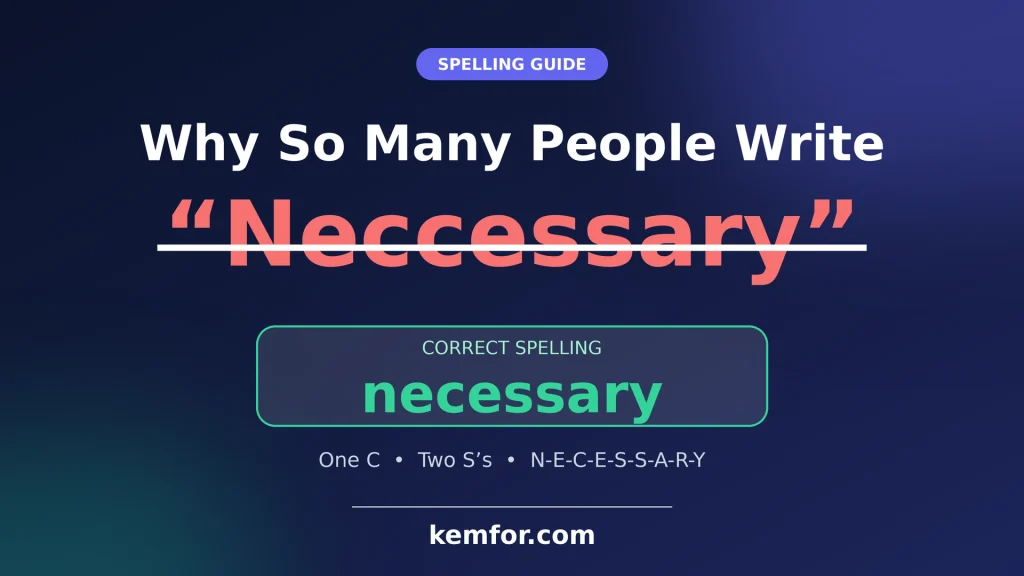
The short answer: necessary is the only correct spelling. Neccessary is a misspelling and does not appear in any standard dictionary. The correct form has one C and two S’s, and it begins with the letters N-E-C-E-S-S.
The rest of this guide goes beyond that one-line answer. You’ll see why the error is so common, where the word comes from, a few memory devices that work, and how to use the word and its relatives with confidence in professional and academic writing.
The Quick Answer: Necessary Is Correct, Neccessary Is Not
Here is the spelling at a glance:
- Correct: necessary
- Incorrect: neccessary, necesary, neccesary, necessery, nessessary
The pattern to lock in is one C, two S’s. Split it into syllables and it reads nec-es-sar-y. The first C sits alone, and the doubled letters come later, in the middle of the word.
A sentence to test yourself with: “It is not always necessary to apologize, but it is often wise.” Cover the word and try to type it from memory. If you land on N-E-C-E-S-S-A-R-Y, you have it.
Why So Many People Write “Neccessary”
Misspellings are rarely random. They usually reveal how our brains process words, and “neccessary” is a good example.
The Double-Letter Trap
English has a habit of doubling consonants in unpredictable places. When a word contains two sets of doubled letters, as in committee, address, or embarrass, writers often misplace one of them. The brain remembers that something is doubled, but not which letter. With necessary, only one letter is doubled (the S), yet many people expect more doubling than there actually is.
Interference From Look-Alike Words
Words you see often shape your spelling expectations. Consider these:
- success (double C, double S)
- accessory (double C, double S)
- accessible (double C, double S)
- necessary (single C, double S)
Because success, accessory, and accessible all share a “cc + ss” rhythm, the brain tends to overgeneralize. Writers import the doubled C into necessary because it feels like it belongs to the same family. It doesn’t.
The Sound Gives No Clues
When you say the word aloud, you hear something like “NESS-uh-sair-ee.” Nothing in that sound signals whether the C is single or double, or how many S’s there are. English spelling often depends on history rather than pronunciation, and this word is a clear case.
A Brief Look at the Word’s Origins
The word comes from the Latin necessarius, meaning “unavoidable” or “indispensable,” which is linked to the Latin necesse, meaning “needful” or “unavoidable.” It entered English through Old French and has been part of the language for many centuries.
Many etymologists connect the -cess- portion to the Latin verb cedere, which means “to go, yield, or withdraw.” That root also appears in words like recede, proceed, exceed, and concede. The idea, loosely, is something that cannot be yielded or avoided. You do not need to memorize this for everyday writing, but it explains why the middle of the word is built around “cess.” If you remember recess, process, and excess, you have the same “-cess” skeleton, and necessary simply adds a prefix to it.
Memory Tricks That Actually Work
Rote repetition rarely fixes a spelling problem for good. A mental hook does. Here are the ones that tend to stick.
The Shirt Mnemonic: One Collar, Two Sleeves
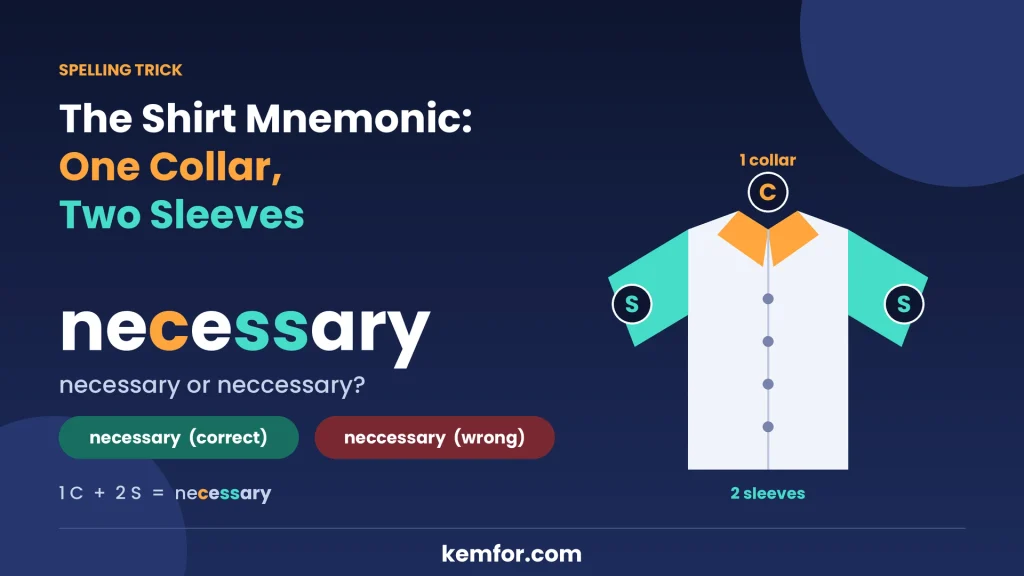
A classic and surprisingly effective device: a necessary shirt has one Collar and two Sleeves. One C, two S’s. The image is silly enough to remember and specific enough to settle any doubt when you’re mid-sentence.
Break It Into Chunks
Splitting a long word into small pieces makes it far easier to hold in memory. Try this:
NE – CE – SS – ARY
Say it as four beats in your head while typing. The “SS” chunk is the only doubled part, and it comes right in the middle.
Anchor It to “Cess” Words
Link the word to others that share its core: recess, process, success, excess. If you can spell any of these, you can spell the middle of necessary. Just remember that success is the one that takes an extra C at the front.
Write It Correctly Ten Times in Real Sentences
Copying a word in isolation trains your hand, not your understanding. Write it ten times inside meaningful sentences instead, ideally about your own life or work. “Is it necessary to attend the meeting?” “I only bring what’s necessary.” The context attaches the spelling to meaning, which is how long-term memory prefers to work.
What Does “Necessary” Actually Mean?
Spelling is only half the picture. Using the word precisely matters just as much.
Necessary is an adjective describing something that must exist, happen, or be done, either because the situation demands it or because a goal cannot be reached without it. It carries a stronger meaning than “helpful” or “useful,” and it sits close to “essential” and “required.”
Three shades of meaning are worth separating:
- Practical need: Something you cannot do without. “A passport is necessary for international travel.”
- Logical need: Something that must be true for a conclusion to hold. “Oxygen is necessary for combustion.”
- Unavoidable consequence: Something that follows inevitably. “Delays were a necessary result of the storm.”
Keeping these shades in mind helps you choose between necessary and softer alternatives when you want your wording to be accurate.
Necessary vs. Needed vs. Required vs. Essential
These four words overlap, yet they are not interchangeable in careful writing.
- Necessary suggests that something cannot be skipped if you want a particular outcome.
- Needed is more personal and informal, pointing to a lack that should be filled.
- Required points to an external rule or demand. A form may be required by law even when it feels pointless.
- Essential emphasizes fundamental importance, the core without which something loses its identity.
A quick illustration: A fire extinguisher may be required by a building code, necessary for safety, needed if a kitchen fire breaks out, and essential in any restaurant. The same object, four slightly different framings. Choosing the right one gives your writing precision that readers notice even if they cannot say why.
Related Words and Their Correct Spellings
Once you have necessary down, its relatives are easy. The core spelling stays stable.
Necessarily
The adverb form simply adds -ly: necessarily. It appears most often in the phrase “not necessarily,” as in “Expensive does not necessarily mean better.” The root stays intact, so there is no extra letter to worry about.
Necessity
This noun, meaning something required or the state of being required, drops the double S. It has one S in the middle: necessity. It’s a common error to carry the double S over from necessary, so watch for that.
Necessitate
The verb meaning “to make something necessary” also uses a single S: necessitate. Example: “The new regulations necessitate a full audit.”
Unnecessary and Unnecessarily
The prefix un- attaches without changing anything: unnecessary, unnecessarily. You end up with a double N at the start, which is correct and expected, because the prefix ends in N and the root begins with N. Many writers mistakenly delete one N, producing “unecessary,” which is wrong.
A Compact Reference
| Word | Part of Speech | Key Spelling Detail |
|---|---|---|
| necessary | adjective | one C, two S’s |
| necessarily | adverb | adds -ly |
| necessity | noun | one S |
| necessitate | verb | one S |
| unnecessary | adjective | double N at the start |
| unnecessarily | adverb | double N at the start |
Common Phrases and Expressions Using “Necessary”
The word anchors a number of fixed phrases worth knowing, both for spelling practice and for natural usage.
- “If necessary”: a conditional safety net. “We will reschedule if necessary.”
- “By any means necessary”: a phrase meaning that one will use whatever methods are required to achieve a goal.
- “Necessary evil”: something unpleasant but unavoidable. Many people describe taxes or performance reviews this way.
- “Necessary and sufficient”: a phrase used in logic and mathematics. A condition is necessary if the outcome cannot occur without it, and sufficient if it guarantees the outcome. Being at least a certain age may be necessary to vote, for example, but it is not sufficient on its own, since registration rules also apply.
- “The Necessary and Proper Clause”: a provision in Article I, Section 8 of the United States Constitution that gives Congress the authority to make laws needed to carry out its listed powers. It is a well-known example of the word appearing in a foundational legal text.
Using “Necessary” Correctly in a Sentence
Grammar matters as much as spelling. Here are the patterns that come up most.
Necessary + to + Verb
“It is necessary to verify your identity.” This is the most natural, flexible construction.
Necessary + for + Noun or Person
“A strong password is necessary for account security.” “Rest is necessary for recovery.” The word for introduces the person or purpose that requires the thing.
It Is Necessary That + Subjunctive
In formal writing, a that-clause after necessary often takes the subjunctive: “It is necessary that every applicant submit a form.” Note submit, not submits. In American English this form is common in legal and academic contexts. British English frequently uses “should submit” instead. Both are acceptable, so match your audience.
Placing the Word After a Noun
Occasionally the word follows the thing it describes, especially in fixed expressions: “We took the steps necessary to resolve the issue.” This is correct and reads as slightly formal.
Practical Examples in Everyday, Academic, and Professional Contexts
Seeing the word in realistic settings makes it feel less abstract.
Everyday life: “Is it necessary to arrive an hour early for a domestic flight?” Airlines often advise this, but whether it is truly necessary depends on the airport and your luggage situation.
Academic writing: “Establishing a control group is necessary to isolate the effect of the treatment.” Here the word signals a logical requirement of good research design.
Business communication: “Please include only the information necessary for the decision.” This phrasing is direct without being curt, and it avoids padding.
Email etiquette: Instead of “It is absolutely necessary that you reply immediately,” try “A reply by Friday would help us move forward.” Overusing necessary can make a message sound demanding, so reserve it for real requirements.
How to Avoid Spelling Mistakes Like This in the Future
Fixing one word helps, but building habits protects you across all the tricky ones.
Don’t Rely Entirely on Autocorrect
Spell checkers catch “neccessary” easily, but they miss real-word errors, such as typing stationary when you meant stationery. Use them as a safety net, not a substitute for knowing the word.
Keep a Personal “Trouble Words” List
Most people struggle with the same ten to twenty words repeatedly. Write yours down. Include the correct spelling and one memory hook beside each. Review the list for a minute before a major writing task.
Read Your Work Aloud or Backward
Reading aloud slows you down enough to catch typos. Reading a draft from the last sentence to the first breaks the narrative flow so your eyes see individual words instead of skimming ahead.
Pay Attention When You Pause
If you hesitate while typing a word, that hesitation is useful data. It means your confidence is low. Stop and check it right then, not later. Over time, those quick checks convert uncertain words into automatic ones.
Is “Neccessary” Ever Acceptable?
No. Unlike some words with legitimate regional variants, such as color and colour, there is no accepted alternative spelling of necessary in American, British, Canadian, or Australian English. Every major dictionary lists one form only. If you see “neccessary” in published writing, it is a typo.
This matters in professional contexts. A misspelling in a cover letter, product page, or academic submission can quietly undermine a reader’s trust, even when the content itself is strong. People may not consciously register the error, but it often shapes their impression of care and credibility.
Conclusion
The correct spelling is necessary, with one C and two S’s. “Neccessary” is simply a misspelling, one that grows out of the brain’s tendency to double the wrong letters in a word that sounds like it might contain extras. The fixes are straightforward: picture the shirt with one collar and two sleeves, break the word into ne-ces-sar-y, and link it to its “-cess” cousins like recess and process.
Beyond spelling, remember its relatives: necessity and necessitate shrink to a single S, while unnecessary keeps a double N. And in your writing, use necessary when something truly cannot be skipped, saving gentler words for gentler situations.
Frequently Asked Questions (FAQ)
Is it “necessary” or “neccessary”?
The only correct spelling is necessary, with one C and two S’s. “Neccessary” is a common misspelling and is not accepted in any standard dictionary.
How many C’s and S’s are in “necessary”?
The word has one C (appearing twice in the word, but never doubled) and two S’s that sit side by side in the middle. To be precise, the letters are N-E-C-E-S-S-A-R-Y, which contains two separate C’s, each standing alone, and one pair of S’s.
What is a simple trick to remember how to spell “necessary”?
Picture a shirt: it has one collar and two sleeves, which stands for one C and two S’s. Another approach is to chunk it as NE-CE-SS-ARY.
What is the difference between “necessary” and “necessity”?
Necessary is an adjective describing something required. Necessity is a noun naming the thing that is required or the state of being required. Note the spelling difference: necessary has a double S, while necessity has a single S.
Is “unnecessary” spelled with one N or two?
It has two N’s: un-necessary. The prefix un- ends in N and the root necessary begins with N, so both letters stay. Writing “unecessary” is an error.
Can “necessary” be used as a noun?
Rarely. In older or formal usage, “necessaries” can refer to essential items, as in “the necessaries of life.” In modern writing, necessity or essentials is the more natural choice.
What does “not necessarily” mean?
It means “not always” or “not inevitably.” For example, “A higher price does not necessarily mean higher quality” means that the two sometimes go together but cannot be assumed to.
Is there a British and American difference in spelling “necessary”?
No. The spelling is identical across American, British, Canadian, and Australian English. The only difference you may notice is in pronunciation and in how certain sentence structures, such as the subjunctive, are preferred.
Why does spell check sometimes not catch errors with this word?
Spell checkers usually flag “neccessary” immediately. Problems arise when a typo accidentally forms a different real word, or when someone ignores or auto-accepts a suggestion without reading it. Proofreading remains important.
What are good synonyms for “necessary”?
Depending on context: essential, required, vital, indispensable, needed, mandatory, and requisite. Choose based on tone and strength, since they are not perfect equivalents.