Few words cause as much quiet hesitation as this one. You type it, the cursor pauses, and something about the shape on the screen feels off. Was it two r’s or one? Two c’s or one? You glance at the red underline, hit the suggestion, and move on, never quite learning why.
This guide ends that cycle. You will see which spelling is right, and you will also understand the rule that produces it. Once you see the mechanism, you stop memorizing one stubborn word and start recognizing a whole family of them. Along the way we cover meaning, pronunciation, word origin, real usage, and the grammar mistakes that tend to travel with this verb.
Quick Answer: “Occurred” Is the Correct Spelling
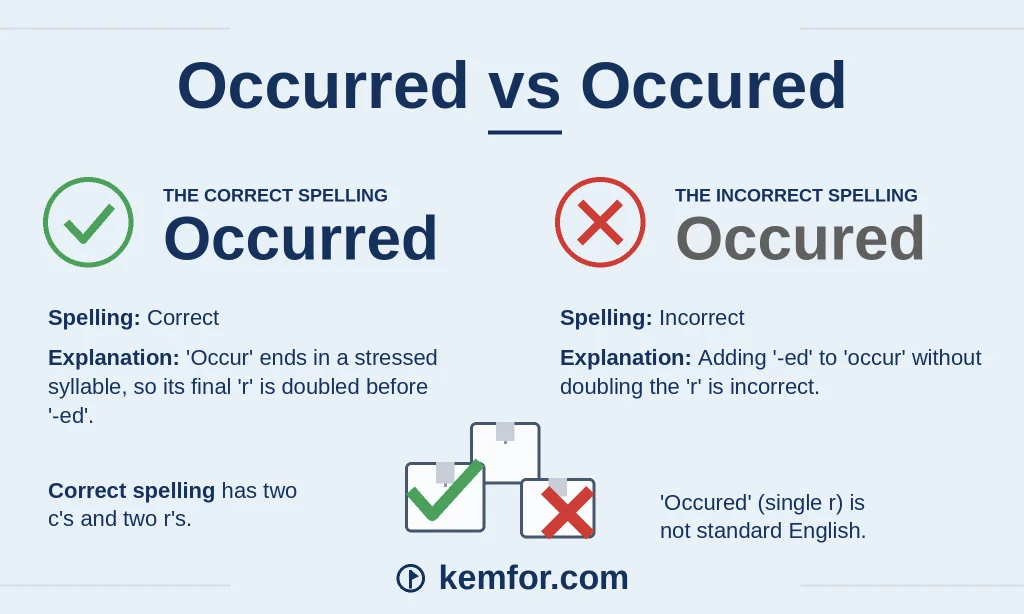
Occurred is correct. Occured is a misspelling. The word needs two c’s and two r’s: o-c-c-u-r-r-e-d.
Occurred is the past tense and the past participle of the verb occur. Whenever you need to say that something happened, took place, or came to mind in the past, this is the form you want.
- The accident occurred shortly after midnight.
- It never occurred to her that the deadline had moved.
- Several errors have occurred since the update.
No major English-language dictionary treats occured as an acceptable alternative. It is not a regional variant or a stylistic choice. It is simply a slip, and a very common one.
Why “Occured” Looks Right but Isn’t
A misspelling this widespread is not a sign of carelessness. It is a sign that the correct spelling hides information the ear cannot supply. Understanding the trap is the first step to avoiding it.
The Sound Trap
Spoken English does not pronounce double letters as doubled sounds. When you say the word aloud, you hear a hard “k” sound and a single “r” sound. Nothing in the pronunciation tells you that two c’s and two r’s are hiding in the written form. Spelling by ear leads straight to occured, or sometimes ocurred.
The Half-Remembered Pattern
Most people who write occured actually know the word has a doubled letter somewhere. They remember the double c, because it sits at the front, where the eye lands first. The second doubling, tucked in just before the ending, is the one that slips away. The misspelling is often a partial memory rather than total ignorance.
The Spelling Rule That Explains Occurred
Here is the good news: you do not need to rely on memory alone. English has a dependable pattern for adding endings such as -ed and -ing to verbs, and occur follows it exactly.
The Consonant Doubling Rule, Step by Step
When you add a suffix that begins with a vowel (-ed, -ing, -ence), you double the final consonant of the base word if all three of these conditions hold:
- The word ends in a single consonant, such as the r in occur.
- That consonant is preceded by a single vowel, here the u.
- The final syllable carries the main stress, so we say oc-CUR, not OC-cur.
Occur passes every test. It ends in a lone r, after a lone u, in a stressed final syllable. So the r doubles before the ending arrives: occur → occurred, occurring, occurrence.
Why “Occur” Doubles but “Offer” and “Happen” Do Not
Compare occur with two verbs that look similar on the page.
- Offer is stressed on the first syllable (OF-fer). The final syllable is unstressed, so no doubling happens: offered, offering.
- Happen is stressed on HAP. Again the last syllable is weak, so the result is happened, not happenned.
Stress is the deciding factor. Once you can hear where the emphasis falls, the spelling follows almost automatically. Say “oc-CUR” out loud and listen to the weight landing on the final syllable. That weight is the signal to double the r.
The Occur Word Family at a Glance
Because the doubling rule travels with the verb, every form built from it carries two r’s. Here is the whole family in one place.
| Form | Role | Example |
|---|---|---|
| occur | base verb | Storms rarely occur here in spring. |
| occurs | third-person singular | The error occurs when the file is large. |
| occurred | past tense and past participle | The fire occurred overnight. |
| occurring | present participle | The symptoms are occurring more often. |
| occurrence | noun | The occurrence of frost was unusual. |
| occurrences | plural noun | Repeated occurrences were logged. |
Notice that occurs is the one exception to the doubled r, since the ending -s is not a vowel-initial suffix. It stays plain. Everything else in the family keeps the pair.
What “Occurred” Actually Means
At its core, to occur means to come about, to take place, or to present itself. Occurred simply places that event in the past. The word carries two related shades of meaning worth separating.
Occurred as an Event Taking Place
In its most common use, occurred reports that something happened, usually something notable, unplanned, or worth recording.
- A power outage occurred during the match.
- The earthquake occurred at a shallow depth.
- When the data entry error occurred, nobody noticed for a week.
The word often carries a neutral, slightly formal tone. It states what happened without drama.
Occurred as a Thought Arriving
The second meaning is quieter. When an idea or realization arrives in someone’s mind, the phrase is occur to.
- It suddenly occurred to him that he had left the oven on.
- Did it ever occur to you to ask for a second opinion?
This construction is one of the most natural uses of the verb, and it is a good reminder that occur is not limited to physical events. It also works for mental ones.
How to Pronounce “Occurred”
The word has two syllables, with the stress on the second: uh-KURD. In American English the r is clearly sounded, giving something like /əˈkɜːrd/. In many British accents the r is softened, giving /əˈkɜːd/.
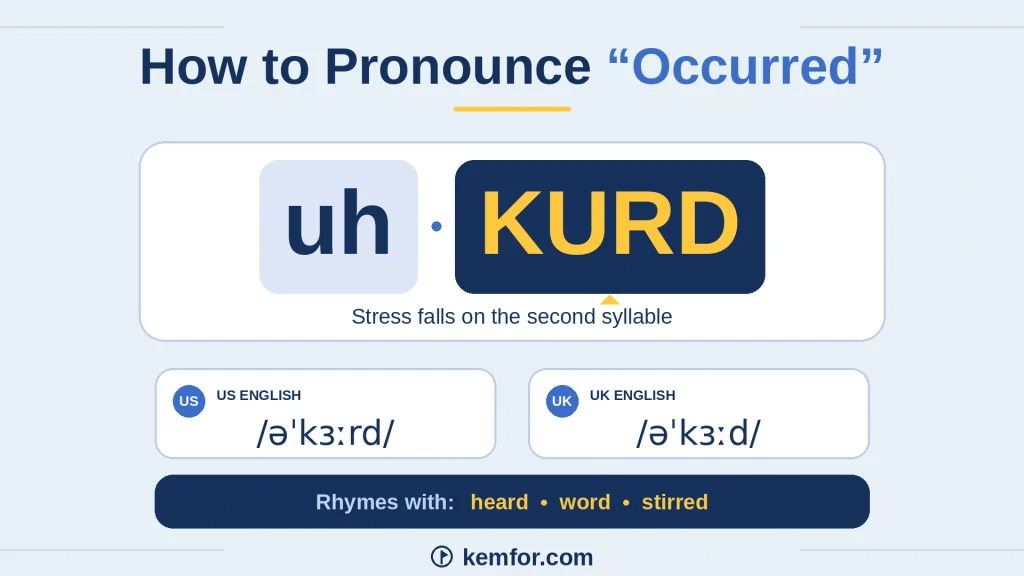
It rhymes with word, heard, and stirred. That last rhyme is useful, because stirred also doubles its r under the same rule (stir is a single-syllable word with a short vowel and a lone final consonant).
Where the Word Comes From
The verb reached English from Latin, in the early modern period. Its source is occurrere, which means to run toward or to meet, built from ob- (toward, against) and currere (to run). The image is almost physical: an event runs toward you and meets you.
This ancestry explains the family resemblance with other -cur words, because currere is also the root behind current, recur, incur, concur, and occur. If you have ever wondered why these verbs behave so similarly in spelling, they share the same Latin core, and their English endings follow the same doubling rule. The doubled c in the opening of occur also comes from Latin, where the prefix ob- assimilated to the following consonant.
“Occurred” in Real Sentences
Examples teach the rhythm of a word better than definitions can. Here is how occurred appears in different writing contexts.
Everyday Writing
- The misunderstanding occurred because we both assumed the other would call.
- Nothing unusual occurred on the trip home.
- A strange coincidence occurred last Tuesday.
In casual writing, you will often see happened in these slots instead. Both work, and the choice comes down to tone, which we will compare shortly.
Professional and Technical Writing
Anyone who uses software has met this word in an error message: “An unexpected error occurred.” Developers and support teams rely on it because it is brief and neutral. It reports that something went wrong without assigning blame or guessing at the cause.
Incident reports lean on the same word. A typical line might read: “The outage occurred at 14:05 and was resolved at 14:40.” The word anchors the event in time, which is exactly what a log entry needs.
Academic and Legal Writing
In research writing, occurred appears whenever a study describes events or observations: “Significant changes occurred in the treatment group after six weeks.” In legal and insurance settings, the phrase date of occurrence identifies when a reportable event took place. Precision matters most in these settings, and a misspelling in a formal document can quietly erode a reader’s trust in everything around it.
Occurred vs. Happened vs. Took Place
Writers often wonder whether these three are interchangeable. They overlap heavily, but each has a natural habitat.
Occurred is the formal, neutral choice. It suits reports, news writing, and technical documentation. It often describes events that were not planned.
Happened is the conversational choice. It feels at home in speech, storytelling, and informal emails. “What happened last night?” sounds natural; “What occurred last night?” sounds like a detective is asking.
Took place usually describes scheduled or organized events. A wedding, a meeting, or a ceremony takes place. A sudden malfunction more naturally occurs.
Consider the pair: “The conference took place in March” versus “An error occurred during the conference.” The first is an arranged event, the second an unplanned one. Matching the verb to the nature of the event is a small choice that makes writing feel more precise.
Common Grammar Mistakes with “Occurred”
Spelling is only half the story. A few grammatical slips tend to appear alongside this verb.
“Was Occurred” and Other Passive Errors
Occur is an intransitive verb, meaning it never takes a direct object, and so it cannot be turned into a passive. You cannot write “The accident was occurred.” The correct version is simply “The accident occurred.” If you notice yourself reaching for was before the word, stop and delete it.
Mixing Up Tenses
Because occurred serves as both simple past and past participle, it fits two structures:
- Simple past: “The delay occurred on Monday.”
- Perfect tenses: “The delay has occurred twice this month.” / “The delay had occurred before we arrived.”
Use occurs for habitual or present-tense facts (“Such delays occur often”) and occurring for ongoing events (“The delays are occurring more frequently”).
Reoccurred vs. Recurred
Both recur and reoccur mean to happen again, and both are accepted. Recur is the more established choice, particularly when something happens repeatedly or periodically, as in a recurring appointment or a recurring dream. Either way, the doubled r is mandatory in the past tense: recurred and reoccurred.
Other Misspellings in the Occur Family
If you write occured, you may also stumble on its relatives. Watch for these frequent errors:
- Occurence (should be occurrence): the doubled r disappears before -ence.
- Occurance (should be occurrence): the ending is -ence, not -ance.
- Ocurred or ocurrence: the opening double c is dropped.
- Occuring (should be occurring): the r fails to double before -ing.
Notice the pattern. Nearly all of these mistakes involve the same two spots: the pair of c’s and the pair of r’s. If you check those two places every time, you will catch almost every variant.
Memory Tricks That Actually Help
Mnemonics work best when they attach to something meaningful rather than something silly. Here are three approaches, from simplest to most durable.
The count method. Say to yourself: “two c’s, two r’s.” Then glance at the word and tally them. It takes two seconds and covers every form in the family.
The sound-and-stress method. Say the word with exaggerated emphasis on the second syllable: oc-CUR. If the stress lands on the last syllable before the ending, the consonant doubles. This transfers to dozens of other verbs.
The sibling method. Link occurred to words you already spell correctly. If you are confident about stirred, preferred, or referred, remind yourself that occurred works the same way. You are borrowing certainty you already have.
Pick whichever feels natural, and use it deliberately for a week. After a handful of repetitions, the correct spelling begins to look right and the wrong one starts to look wrong, which is the real goal of spelling practice.
Words That Follow the Same Pattern
Learning the rule pays off beyond a single word. These verbs all end in a stressed syllable with a single vowel and consonant, so they double before -ed and -ing:
- prefer → preferred, preferring
- refer → referred, referring
- transfer → transferred, transferring
- admit → admitted, admitting
- commit → committed, committing
- permit → permitted, permitting
- regret → regretted, regretting
- incur → incurred, incurring
- recur → recurred, recurring
- deter → deterred, deterring
Now compare verbs where the stress falls earlier, which do not double: visit → visited, open → opened, listen → listened, offer → offered, develop → developed. Seen side by side, the logic is clear. The rule is not a pile of random exceptions. It is a consistent principle tied to how words are pronounced.
A small caution: a few words bend the rule in certain varieties of English. For instance, British spelling often doubles an l even in unstressed syllables (travelled, cancelled), where American spelling keeps one. That is a separate quirk about the letter l, and it does not affect occurred.
Is “Occurred” Spelled Differently in British and American English?
No. Both varieties use the same spelling. The differences between UK and US English that people usually worry about, such as colour versus color or organise versus organize, simply do not apply here. Whether you are writing for readers in London, Lahore, or Los Angeles, occurred is the form to use, and occured is an error in every one of those places.
Quick Practice: Test Your Instincts
Fill in each blank with the correct form of occur. Answers follow.
- The power failure __________ just before the presentation started.
- It never __________ to me to check the attachment.
- These errors have been __________ since the last release.
- Any unusual __________ should be reported immediately.
- The problem __________ whenever the cache is full.
Answers:
- occurred
- occurred
- occurring
- occurrence
- occurs
If you got one wrong, look at which suffix tripped you. Remember that the third-person present form (occurs) is the only one that skips the double r.
Proofreading Tips for Writers and Editors
Because spell checkers flag occured reliably, the greater risk is autopilot acceptance, where you click the first suggestion without reading. A few habits help.
- Search your document for single-r variants. Searching for “occure” and “occurence” takes seconds and catches stragglers.
- Read the last pass aloud. Slowing down changes how your eyes process each word.
- Keep a personal list. Editors and students alike benefit from a short list of their own recurring errors. If occurred sits on yours, review it before submitting anything important.
These habits matter most in documents where credibility is on the line, such as résumés, cover letters, reports, and client emails. A single misspelling will not ruin a document, but readers form impressions quickly, and clean spelling signals care.
Conclusion
The answer to the question is simple: occurred is correct, and occured is a misspelling. The more useful lesson sits underneath that answer. Occur ends in a single consonant after a single vowel, and its stress falls on the final syllable, so the r doubles before the vowel suffixes -ed, -ing, and -ence. That one principle also gives you preferred, referred, committed, and a long list of others.
Keep the count in mind, two c’s and two r’s, and use the stress test when you meet an unfamiliar verb. With the rule in hand, you can write this word without the old pause, and you can help others do the same.
Frequently Asked Questions
Is it “occured” or “occurred”?
The correct spelling is occurred. It has two c’s and two r’s. “Occured” is a common misspelling and is not accepted in standard writing.
Why does “occurred” have two r’s?
The verb occur ends in a single vowel followed by a single consonant, and its final syllable is stressed. Under English spelling rules, that consonant doubles when a vowel-initial ending such as -ed is added.
What is the past tense of “occur”?
The past tense is occurred. The same form serves as the past participle, as in “has occurred” and “had occurred.”
How do you spell the noun form?
The noun is occurrence, with two c’s, two r’s, and an -ence ending. Common errors include “occurence” and “occurance.”
Can I say “was occurred”?
No. Occur is intransitive, so it does not form a passive. Write “The error occurred,” not “The error was occurred.”
What is the difference between “occur” and “happen”?
Both describe events taking place. Occur is more formal and common in reports and technical writing, while happen is more conversational. Take place is typically used for planned events.
Is “occurred” the same in British and American English?
Yes. The spelling is identical in both varieties, so no regional adjustment is needed.
How do you pronounce “occurred”?
Say uh-KURD, with the stress on the second syllable. It rhymes with heard and word.