You are typing a quick message, a cover letter, or a reply to a colleague. You reach for the word that means “without question,” and your fingers stall. Is that middle vowel an i or an a? You write it both ways, squint at the screen, and still can’t tell which looks right.
You are not alone. This word is one of the most reliably misspelled in English, and the reason has little to do with carelessness. It has to do with how English builds words, how we pronounce them, and how our eyes fill in patterns we have seen a thousand times before.
This guide settles the question and explains why the answer holds. You will also get memory tricks, a map of the look-alike words that cause trouble, and a short proofreading routine you can use whenever this word turns up in your writing.
Quick Answer: “Definitely” Is the Only Correct Spelling
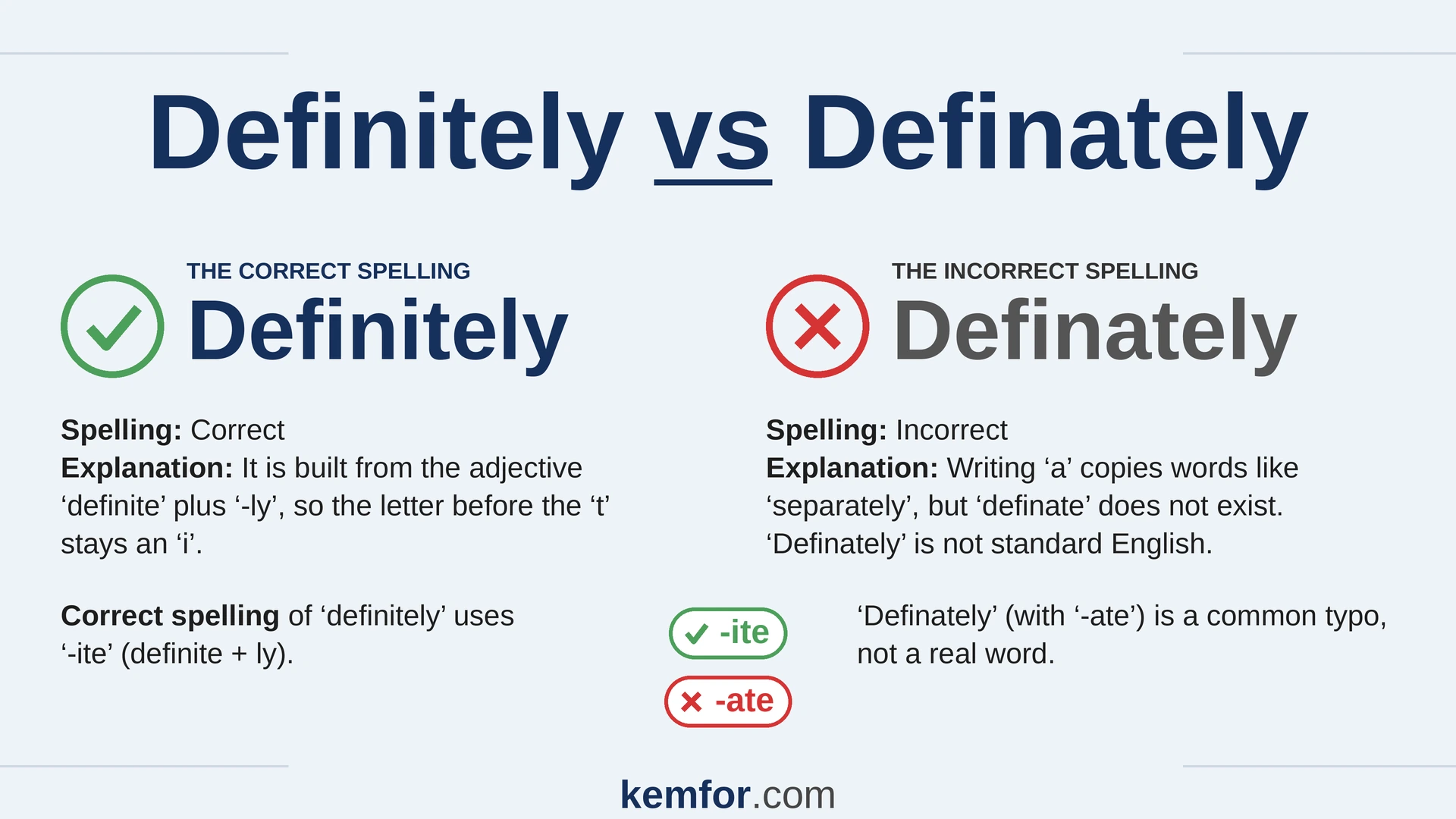
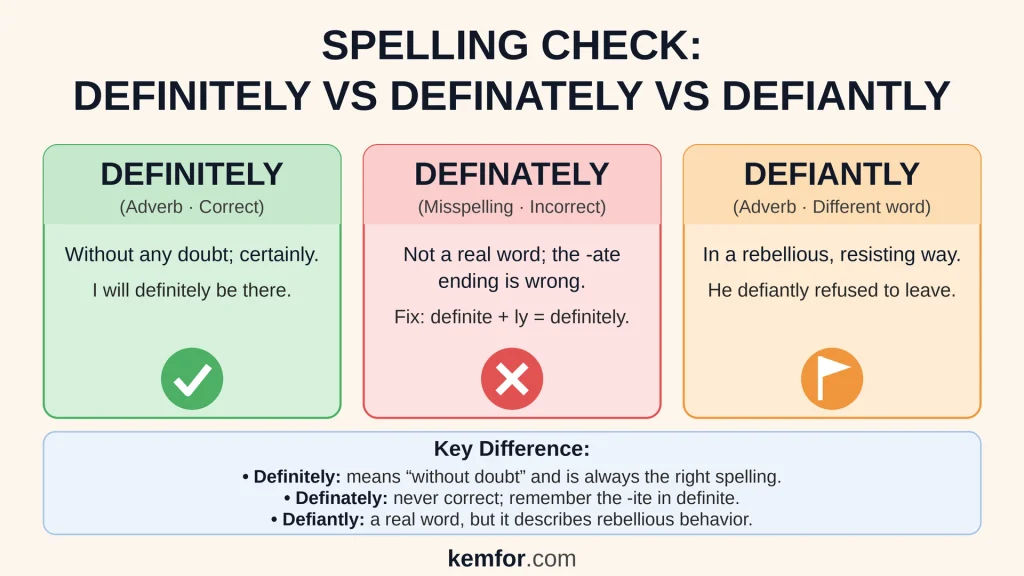
In the contest of definitely or definately, definitely is correct and definately is always a misspelling. No dictionary lists the -ately version as an acceptable variant, in American, British, Canadian, or Australian English.
| Spelling | Status | Notes |
|---|---|---|
| definitely | Correct | Adverb meaning “without doubt” or “clearly” |
| definately | Incorrect | A phonetic guess that follows the wrong pattern |
| definatly | Incorrect | Drops a letter and uses the wrong vowel |
| definetly | Incorrect | Gets the vowel wrong in a different place |
| defiantly | Correct, but a different word | Means “in a defiant manner” |
If you only remember one thing, remember this: the word is built from definite plus -ly, and definite ends in -ite, never -ate.
What Does “Definitely” Mean?
Before the spelling, a quick look at the meaning, because the meaning explains the structure.
The Core Meaning
“Definitely” is an adverb that expresses certainty or clarity. When you say a deadline is definitely Friday, you are saying there is no ambiguity about it. When you say a painting is definitely a forgery, you are saying the evidence leaves no reasonable room for doubt.
Its meaning is tied to a quality of precision. Something definite has clear limits. It is settled, fixed, and not vague. The adverb applies that clarity to an action or a judgment.
“Definitely” as an Emphatic Reply
In conversation, “definitely” often works as a standalone answer. Someone asks, “Are you coming Saturday?” and you answer, “Definitely.” It carries more force than “yes” and signals real commitment or strong agreement.
It also works in the negative: “Definitely not” is a firm refusal with no softening. In both directions, the word tells the listener that the matter is closed.
Why “Definately” Is Wrong
The error comes down to word construction. English adverbs of this type are assembled from smaller parts, and the parts here are fixed.
The Word-Building Logic: Definite + ly
Start with the adjective definite. Add the suffix -ly, which turns many adjectives into adverbs, and you get definitely. The adjective is not changed in the process. It keeps its final e because the suffix begins with a consonant.
Compare the pattern with other adverbs:
- complete becomes completely
- sincere becomes sincerely
- definite becomes definitely
Each time, the base word stays intact and -ly gets attached. For “definately” to be correct, the adjective would have to be “definate.” That word does not exist.
The “-ate” Trap
This is where the confusion lives. English has a large family of words ending in -ate, including separate, desperate, accurate, moderate, fortunate, and immediate. Their adverbs look like this: separately, desperately, accurately, moderately, fortunately, immediately.
Those adverbs are all perfectly correct. So when your brain reaches for an adverb that ends in -tely, it has plenty of correct examples with an a before the t. “Definately” feels like it belongs to that group. It doesn’t. Definite belongs to a smaller family of words ending in -ite, such as infinite, opposite, favorite, composite, and exquisite.
The History Behind the Word
Knowing where a word came from often makes its spelling stick. Definite traces back to the Latin verb definire, meaning “to set boundaries around” or “to determine.” That verb combines the prefix de- with finis, the Latin word for “end” or “limit.”
Definite entered English around the sixteenth century, and the idea behind it has stayed constant. Something that is definite has been given edges. It has an end, a boundary, a clear shape.
Finis left a large footprint in English. The same root sits inside final, finish, confine, refine, finite, and infinite. The family resemblance is exactly the clue spellers need, and we will use it in the memory tricks below.
Why Almost Everyone Misspells It
Misspelling this word is a predictable result of how English works, not a personal failing. Two forces combine to produce it.
The Unstressed Vowel Problem
Say the word aloud at normal speed: DEF-uh-nit-lee, or often even DEF-nit-lee. The syllable in the middle gets squashed into a weak, barely audible sound that linguists call a schwa. The vowel in the third syllable is also reduced.
When a vowel is that faint, the sound gives you no hint about which letter to write. Your ear cannot tell i from a from e in that position. English spelling is full of this problem, and it is why unstressed syllables are where most misspellings are born.
Pattern Interference From Similar Words
With the sound offering no help, your brain defaults to whichever pattern it has seen most. Words ending in -ate are extremely common, so that pattern wins by sheer volume. It is a statistical error rather than a random one, which is why the same wrong spellings keep appearing across millions of writers.
This also explains why the mistake survives education. Rules about -ite versus -ate are rarely taught explicitly, so most people absorb the pattern by exposure, and exposure points the wrong way.
Memory Tricks That Actually Work
A good memory aid ties the spelling to something you already understand. These two do that.
Find “Finite” Hiding Inside
Look at the middle of the word: de-finite-ly. The word finite sits right there, spelled with an i. If you can spell finite, you can spell definitely.
This trick has an extra benefit. Finite means “having limits,” which connects directly to the Latin root and to the meaning of the word. The spelling hint and the meaning reinforce each other.
Think of the Whole Family
If you want something broader, remember that define, definition, definite, final, and finish are relatives. Notice the i after the f in nearly all of them. When you are unsure, silently run through define and definition. The vowel after f is always i, and the pattern carries over to the adverb.
Common Misspellings and Look-Alikes
The -ately error is only one of several ways this word goes wrong. Knowing the full cast helps you proofread.
Definately, Definatly, and Definetly
- Definately uses the wrong vowel before t but otherwise keeps the structure.
- Definatly makes the same vowel error and also drops the e, as if the word ended in -atly.
- Definetly puts the e in the wrong spot, producing a word that looks plausible but follows no rule.
- Defiantly is a genuine word, which makes it the dangerous one. See below.
Definitely vs. Defiantly
Because defiantly is a real word, spell checkers will not flag it, and autocorrect can sometimes swap one for the other. The two words are unrelated.
Defiantly comes from defiant, meaning openly resistant or rebellious. A teenager who walks out of a room defiantly is making a statement. A teenager who definitely walks out is simply certain to leave.
The sentence “She defiantly wants the job” sounds strange, because a job application is not usually an act of rebellion. When a sentence carries that odd tone, check whether you meant definitely.
Definitely vs. Definitive
Definitive is a separate adjective meaning “conclusive” or “authoritative.” A definitive study settles a question. A definitive answer ends the debate.
You can use “definitely” to modify a verb or adjective, as in “It is definitely over.” You cannot use it in place of “definitive” before a noun. “A definitely guide to birds” is wrong, and the writer wanted “definitive.”
Using “Definitely” in Sentences
Examples across different registers show how flexible the word is.
Everyday Conversation
- “I’ll definitely text you when I land.”
- “That restaurant is definitely worth the wait.”
- “Are you hungry?” “Definitely.”
Professional Settings
- “The report will definitely be ready before the board meeting.”
- “We should definitely clarify the scope before signing.”
- “That vendor is definitely not the right fit for this project.”
Formal and Academic Writing
In formal prose, “definitely” works, but it often does less than writers hope. A sentence like “The data definitely show a decline” leans on the adverb to supply authority that the evidence should supply on its own. Consider whether a precise figure or a stronger verb would serve you better: “The data show a 14 percent decline.”
Where to Put “Definitely” in a Sentence
Placement affects both flow and emphasis.
Before the main verb: “I definitely remember that day.” This is the most natural position in everyday speech.
After an auxiliary verb: “She has definitely improved.” “They will definitely arrive on time.”
Before an auxiliary verb for stronger emphasis: “I definitely will.” This version sounds more insistent, almost like a promise.
Before “not”: “He is definitely not coming.” Putting the adverb ahead of the negative makes the refusal sound complete.
At the end of a clause: “I’ll be there, definitely.” This is acceptable in speech and informal writing but feels loose in a formal document.
One habit to avoid is placing it between a verb and its direct object, as in “I enjoyed definitely the film.” It sounds clumsy to native ears.
Synonyms and When to Choose Them
Variety keeps your writing from sounding repetitive, and each alternative carries a slightly different shade.
- Certainly is polished and works well in professional correspondence.
- Absolutely is stronger and more emotional, good for enthusiastic agreement.
- Undoubtedly is formal and suits analytical or editorial writing.
- Without a doubt is conversational but emphatic.
- Unquestionably is the most formal of the group, suited to arguments and reviews.
- For sure and no question are casual and best kept to speech or relaxed messages.
- Clearly works when the point rests on visible evidence rather than personal conviction.
Choose by tone. “Definitely” sits comfortably in the middle: more committed than “probably,” less formal than “undoubtedly.”
Does Overuse Weaken Your Writing?
Yes, and this is the part most spelling guides skip. “Definitely” is an intensifier, and intensifiers lose power the more often you use them. If every claim in a document is “definitely” true, readers stop noticing the word, and the one place you truly needed emphasis gets lost.
A useful test is to delete the word and reread the sentence. If the meaning is unchanged, the adverb was filler. “This is definitely a great opportunity” works just as well as “This is a great opportunity,” and often reads as more confident.
Save “definitely” for moments when you are resolving real doubt: answering a question, correcting a misconception, or committing to something others might hesitate over.
Does the Spelling Actually Matter?
For a casual text, the stakes are low. In other settings, a single misspelled word can shape how a reader judges you.
On a resume, cover letter, or professional email, a visible typo can suggest inattention, fairly or not. Hiring managers who read hundreds of applications often treat small errors as a quick filter. A word as common as “definitely” is one readers expect you to get right, which makes the error more noticeable, not less.
Students face a similar situation. In graded writing, a repeated misspelling of a common word can cost marks and, more importantly, distract the reader from the strength of the argument.
None of this means perfection is required. It means that spending thirty seconds on the handful of words you personally tend to get wrong pays back disproportionately.
A Simple Routine for Catching the Error
Spell checkers usually flag “definately,” but they are not a complete defense, especially when the typo morphs into a real word like “defiantly.” A short routine covers the gaps.
- Search before you send. Use your editor’s find function to look for “defin” and review each hit. It takes seconds and catches every variant at once.
- Say the pieces aloud. Break it into “de-fin-ite-ly” and spell each piece as you go.
- Check the context. If the word is “defiantly,” ask whether the sentence is really about defiance.
- Keep a personal list. Most writers repeat the same five or six errors. Write yours down and scan for them during final edits.
- Read backward for spelling. Reading a paragraph from the last sentence to the first breaks your attention away from meaning and makes individual words stand out.
Related Word Forms Worth Knowing
Learning the whole family fixes the spelling and widens your vocabulary.
- Definite (adjective): clear, fixed, certain. “We have a definite plan.”
- Definitely (adverb): without doubt. “We will definitely proceed.”
- Indefinite (adjective): unclear or unlimited. “The meeting is postponed for an indefinite period.”
- Indefinitely (adverb): for an unspecified length of time. “The project was delayed indefinitely.”
- Definiteness (noun): the quality of being clear and precise.
- Definite article (grammar term): the word the, which points to a specific noun, as opposed to the indefinite articles a and an.
Notice that every member keeps the -ite ending. The only thing that changes is the prefix or suffix attached.
Conclusion
When you face the choice of definitely or definately, the answer is never in doubt. Definitely is correct, because it is formed from definite plus -ly, and definite ends in -ite. The -ate version is a sound-based guess that borrows its pattern from words like separately and desperately, which is why it feels so convincing.
Keep the memory tricks close: finite hides inside the word, and define and finish share its root. Watch for the defiantly trap, which slips past spell checkers, and use the word with some restraint so it keeps its force. With those habits in place, this stubborn spelling stops being a coin flip and becomes automatic.
Frequently Asked Questions
Is it “definitely” or “definately”?
It is “definitely.” “Definately” is a misspelling that appears because the unstressed vowel in the word sounds like the one in -ate words. No standard dictionary accepts it.
Why do I always spell “definitely” wrong?
Most likely because the vowel in that syllable is weak when spoken, so your ear gives no clue, and your brain substitutes the more common -ate pattern. It is a very common experience, and a reliable memory trick, such as spotting finite inside the word, usually fixes it.
Is “definately” ever acceptable in informal writing?
Not as a standard spelling. It may pass unnoticed in a quick text, but it remains an error, and it can look careless in emails, school work, or professional documents.
What is the difference between “definitely” and “defiantly”?
Definitely means “without doubt.” Defiantly means “in a defiant, resistant way.” They are separate words with different roots, and mixing them up can change the meaning of a sentence completely.
Is “definitely” spelled differently in British and American English?
No. Both varieties use the same spelling. Differences between the two dialects, such as color versus colour, do not affect this word.
How do you pronounce “definitely”?
Most speakers say DEF-uh-nit-lee or DEF-nit-lee. The middle syllables are reduced, which is exactly why the spelling is hard to guess from the sound.
What is the root of the word “definitely”?
It comes from the Latin definire, meaning “to set limits,” built from de- and finis, meaning “end” or “boundary.” The same root appears in finite, final, finish, and infinite.
Can I use “definitely” in academic or formal writing?
Yes, though sparingly. In formal prose, concrete evidence and precise wording usually carry more weight than an intensifier. Reserve “definitely” for places where you are resolving a real question.
What are good alternatives to “definitely”?
Depending on tone, you can use certainly, absolutely, undoubtedly, without a doubt, unquestionably, or clearly. Pick the one that fits the formality of your audience.
What is the quickest way to check my spelling of this word?
Search your document for “defin” and review each result. Then confirm that the middle of the word contains the string finite. If it does, the spelling is right.