Few words humble confident writers the way this one does. You can draft a flawless contract clause, then stall over a single letter in the middle of a word you have typed a thousand times. Is it separate or seperate?
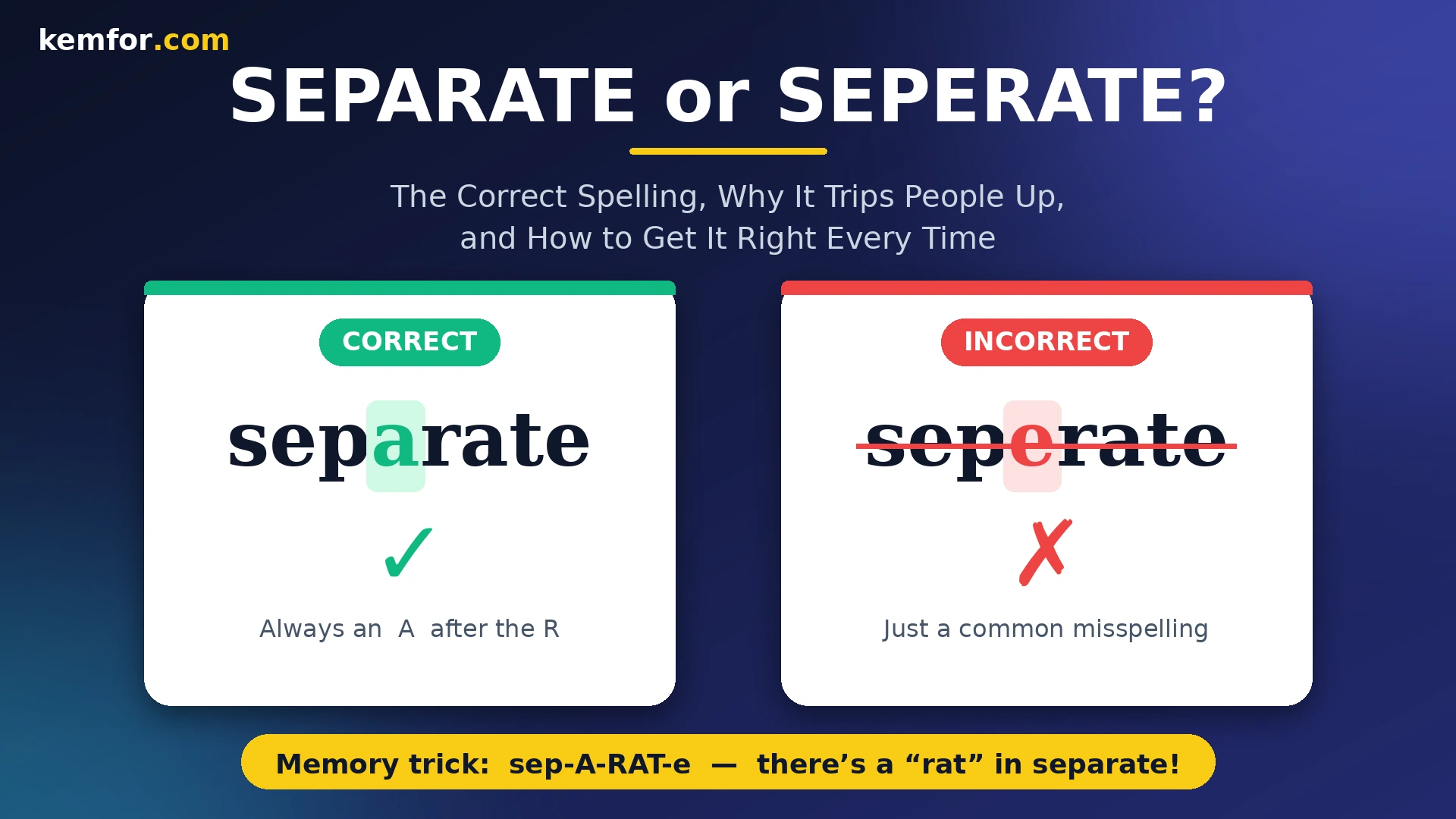
The answer is short: separate is the only accepted spelling. Seperate is a misspelling, and it ranks among the most frequent spelling slips in English. The longer answer is more useful, because knowing why the error happens is what makes it stop happening.
This guide covers what the word means, where it comes from, why the wrong version feels so natural, and the memory tricks that work. You will also get practical habits for catching the mistake in your own writing, along with examples drawn from everyday life, offices, and classrooms.
Quick Answer: Separate Is the Correct Spelling
Use separate. The letters run s-e-p-a-r-a-t-e, with an a in the middle where many people expect an e.
| Version | Status | Example |
|---|---|---|
| separate | Correct | “Keep the invoices separate from the receipts.” |
| seperate | Incorrect | |
| separately | Correct | “We traveled separately.” |
| seperately | Incorrect | |
| separation | Correct | “The separation of duties reduces fraud risk.” |
| seperation | Incorrect |
Every form built on this word keeps the same -par- in the middle. Once you lock that in, the whole family becomes easy.
Why “Seperate” Is Not a Word
Dictionaries do not list seperate as a variant, an alternate spelling, or a regional form. Unlike words such as grey and gray, where two spellings are both valid, this is a plain error with no legitimate second option.
That matters in practice. A misspelling like seperate gets flagged by spell checkers in most word processors, but it can still slip through in places where no checker is running: handwritten notes, text messages, signage, social posts, and fast-typed emails. It also survives when you are tired, rushed, or proofreading your own work, since the brain tends to read what it expects rather than what is on the page.
Treat seperate the way you would treat any typo. There is no context in which it is the better choice, no style guide that endorses it, and no audience that will read it as correct.
Where the Word Separate Comes From
Spelling often makes sense once you see the word’s history, and this one is a good example.
The Hidden “Par” Inside Separate
Separate comes from the Latin verb separare, which combines se- (meaning “apart” or “away”) with parare (meaning “to prepare” or “to arrange”). Put literally, to separate something is to set it apart, to arrange it away from something else.
That Latin root explains the troublesome vowel. The spelling carries the a from parare forward through the centuries. The letter was there at the start, so the modern word keeps it, even though the pronunciation has softened over time.
Relatives That Share the Same Root
The same ancestry shows up in other English words. Etymologists link sever (to cut apart) to the same Latin source, and several originally carried the sense of “distinct” or “separate” before it came to mean “more than two but not many.” Meanwhile parare itself lives on in prepare, repair, and apparatus.
You do not need to memorize any of this. But noticing that prepare and separate share a par can serve as a surprisingly sturdy anchor: if you would never write “preepare,” you have a reason to trust the a in separate.
Why So Many People Write Seperate
If a word is this commonly misspelled, the fault usually lies with the word rather than with the writers. Two forces are at work.
The Weak Middle Vowel
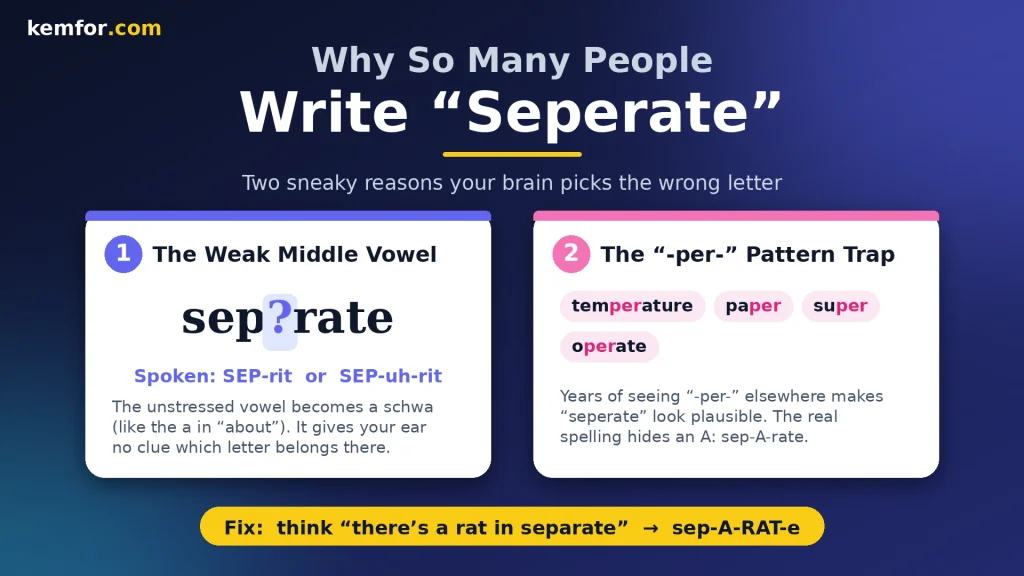
Say the word aloud at a normal speaking pace. For the adjective, most speakers produce something close to SEP-rit, or at most SEP-uh-rit. The vowel in the second syllable is what linguists call a schwa, the relaxed, nearly neutral sound you hear at the start of about or the end of sofa.
A schwa can be spelled with almost any vowel letter. It carries no clue about which one belongs on the page. When your ears give you no information, your eyes have to supply it, and that is where mistakes creep in.
Pattern Matching Gone Wrong
English has plenty of words with a “-per-” cluster: temperature, paper, super, operate, tolerate. After years of seeing “-per-” in other places, the mind quietly predicts it here too. The prediction feels right, so the wrong spelling looks plausible, which is the most dangerous kind of error.
In other words, seperate is not a random slip. It is the spelling that a pattern-seeking brain produces by default. Fixing it takes a deliberate override, and the memory tricks later in this guide are designed to provide exactly that.
How Separate Works as a Verb, Adjective, and Noun
One reason the word feels slippery is that it plays several grammatical roles, and its pronunciation shifts accordingly.
As a Verb
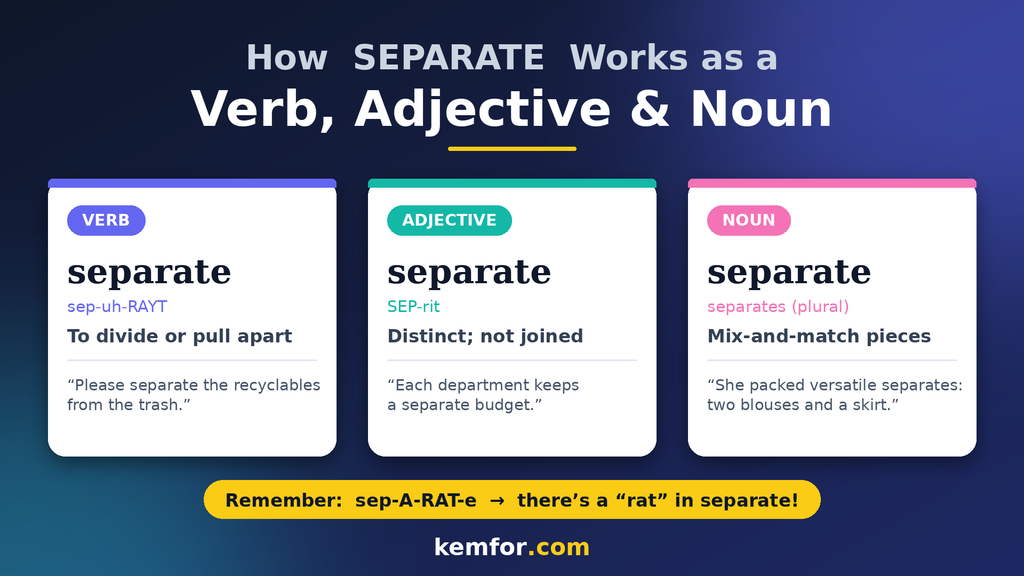
To separate means to pull things apart, divide them, or stop them from being together.
- “Please separate the recyclables from the trash.”
- “The couple decided to separate after a long period of tension.”
- “A narrow strait separates the two islands.”
As an Adjective
Here it means distinct, individual, or not joined.
- “Each department keeps a separate budget.”
- “They sleep in separate rooms because of conflicting schedules.”
- “That is a separate issue, so let’s address it later.”
As a Noun
Less common, but real. In fashion and furniture, separates are individual pieces designed to be mixed and matched.
- “She packed a few versatile separates for the trip: two blouses, a skirt, and linen trousers.”
The Pronunciation Split
The verb and the adjective do not sound identical, and the difference is a handy reminder of the spelling.
- Verb: SEP-uh-rayt, with a full, clear final syllable like the word rate.
- Adjective: SEP-rit or SEP-uh-rit, with a reduced final syllable.
Notice that the verb form practically announces its -ate ending. Pronouncing the verb carefully, even silently in your head, can help you see the a that follows the r.
Separate in Real Sentences
Seeing a word in context builds spelling memory more effectively than studying it in isolation. Here are examples from three common settings.
Everyday Life
- “We split the check, so please make it three separate bills.”
- “Sort the laundry by color and wash the darks separately.”
- “My sister and I grew up in the same house but led completely separate lives.”
Workplace and Professional Writing
- “Please submit the budget proposal and the timeline as separate documents.”
- “Separate accounts for personal and business spending simplify tax season.”
- “The audit team recommended a clear separation of duties between approval and payment.”
In professional documents this word appears constantly, in contracts, policies, reports, and emails. A misspelling here is easy for a reader to spot and can undercut an otherwise careful piece of writing.
Academic and Technical Contexts
- “The chemist used distillation to separate the mixture into its components.”
- “Researchers analyzed the two variables separately to avoid confounding effects.”
- “Good software design relies on the separation of concerns, keeping different responsibilities in different modules.”
The technical sense of the word is the same as the everyday one: keeping things apart so that each can be understood or handled on its own.
The Whole Word Family: Separation, Separately, Separable, and More
Learning the base word correctly means you automatically know the spellings of everything built from it. Here is the full set.
| Word | Part of Speech | Quick Example |
|---|---|---|
| separate | verb / adjective / noun | “Separate the yolks from the whites.” |
| separated | past tense / adjective | “They have been separated for a year.” |
| separating | present participle | “She is separating the files by year.” |
| separately | adverb | “Each item is wrapped separately.” |
| separation | noun | “The separation took months to finalize.” |
| separable | adjective | “The two issues are not easily separable.” |
| inseparable | adjective | “The twins were inseparable.” |
| separator | noun | “Use a separator between the columns.” |
| separatist | noun / adjective | “A separatist movement emerged in the region.” |
| separateness | noun | “The separateness of the two cultures was striking.” |
Every one of these keeps the -par-. If you ever catch yourself writing seperation or seperately, the same fix applies: restore the a.
Separate vs. Apart, Divide, Split, and Sever
Writers sometimes reach for separate when a different word would be stronger or clearer. The synonyms overlap, but each has its own flavor.
- Separate is neutral. It describes things being kept or moved apart without saying how.
- Divide suggests breaking something whole into portions, often with a measurable result: “Divide the profits among the partners.”
- Split is informal and sudden, often implying a clean break: “The group split over the decision.”
- Sever is forceful and final. It means cutting something so that the connection is gone: “The storm severed the power lines.”
- Apart is an adverb or adjective describing distance or disconnection: “The two families live miles apart.”
A useful test is to ask whether the connection could be restored. You can separate two files and rejoin them easily. When something is severed, the break is usually permanent. Choosing the precise word makes your writing sharper, and spelling the word you choose correctly keeps it credible.
Memory Tricks That Actually Work
Rules are hard to apply to a word whose problem spot is a sound your ear cannot hear. Mnemonics work better because they give you something visual to check.
“There’s a Rat in Separate”
This is the most popular trick, and it earns its reputation. Look at the middle of the word: sepARAte. Those letters spell out a-r-a, and the sequence “a rat” appears if you read sep-a-rat-e. Picture a small rat tucked into the center of the word. It is silly, but silly is memorable.
Break It Into Three Chunks
Say it as se – par – ate. The middle chunk is par, a word you already know how to spell. Writing the word in chunks, whether on paper or just mentally, forces the correct letter into place.
Link It to Its Cousins
Connect separate to prepare. Both contain par. If you would never spell the second as “prepere,” the first should look wrong with an e too.
Use the Verb Ending
When you are stuck, mentally pronounce the verb form with its crisp -ate ending: sep-uh-RATE. Emphasizing the sounds that normally disappear can bring the missing letters back into focus.
Pick the one trick that clicks for you and stick with it. Using three at once tends to create more clutter than clarity.
Other Words That Cause the Same Kind of Trouble
Separate belongs to a family of words that trip people up for similar reasons: unstressed vowels that offer no phonetic clue.
- Definite: Writers often drift toward “definate” because the final vowel is reduced. The word comes from the Latin finire, “to limit,” so it carries an i in the -ite ending.
- Desperate: This one is not related to separate, despite the near-rhyme. It comes from Latin desperare, “to lose hope,” and it sits in the same trap, with a weak vowel after the -per-. Careful writers sometimes confuse the two patterns and swap letters between them.
- Occurrence: The double c and double r surprise many writers.
- Existence: The final -ence is easy to mistype as -ance.
- Independent: The -ent ending is routinely confused with -ant.
The lesson is general: whenever a vowel is weak in speech, check the spelling by looking for the word’s root, a related form with a clearer vowel, or a mnemonic. For separate, the clearer relative is the verb, and the root is the Latin par.
How to Catch the Error Before You Publish
Knowing the correct spelling is one skill. Noticing a mistake in your own draft is another, and it is harder because you wrote the text and your brain autocompletes it.
Do Not Rely on Spell Check Alone
Spell checkers catch most instances of seperate, but they are not infallible. A checker may be switched off, may not be present in a given platform, or may be ignored by a hurried writer who clicks past the red underline. Treat it as a backup rather than a safeguard.
Search for the Trouble Spots
Before publishing important writing, run a find-and-replace search for “sepe”. Any result is wrong, because the correct word never contains that sequence. It takes a few seconds and works on documents, web pages, and code comments alike.
Change How the Text Looks
Proofreading on the same screen where you wrote tends to hide errors. Print the page, change the font size, read it aloud, or review it the next day. Small shifts in presentation interrupt the autopilot that lets typos slide by.
Slow Down on High-Stakes Writing
Resumes, cover letters, grant applications, legal documents, and client proposals deserve a deliberate second pass. If separate appears anywhere, check it on purpose.
Why Getting This Spelling Right Matters
A single misspelled word will not ruin a document, but it does shape perception. Readers tend to treat spelling as a proxy for care. When they see an error in a common word, some quietly lower their estimate of the writer’s attention to detail, even if the rest of the content is strong.
The effect is most noticeable in a few settings:
- Job applications: Hiring managers often scan resumes quickly, and visible typos can count against a candidate. A line such as “managed seperate budgets” is the kind of slip that stands out.
- Business communication: Clients and colleagues form impressions of professionalism from emails and proposals.
- Online content: Published pages with obvious errors can weaken trust, and writers who want to be taken seriously benefit from clean copy.
- Education: Teachers and examiners typically mark spelling errors, and this word appears on many commonly misspelled lists for exactly that reason.
None of this means perfection is required. It means that for a word you will use often, a small investment in learning it properly pays off for years.
Common Mistakes With Separate Beyond the Spelling
Even writers who spell the word correctly sometimes stumble over how to use it. A few points are worth keeping in mind.
Use “from” after the verb. You separate one thing from another: “Separate the cream from the milk.” Other prepositions sound off in this construction.
Be careful with “separate out.” The phrase is widely used and generally acceptable in casual speech, but the word “out” often adds nothing. “Separate the invoices” is cleaner than “separate out the invoices,” unless you specifically mean to pull selected items from a larger set.
Do not confuse the adjective with the adverb. The adjective separate describes a noun (“a separate room”). The adverb separately describes an action (“they ate separately”). Writing “they ate separate” is a grammar slip, not a spelling one, but it is equally avoidable.
Watch for redundancy. Phrases like “completely separate and distinct” repeat the same idea twice. One word usually does the job.
Keep the noun sense in mind. In fashion and retail, separates is a legitimate plural noun. It is not a typo for separate.
Conclusion
The spelling question has a one-line answer: separate is correct, and seperate is not. The longer story explains why the mistake is so common. The middle vowel is a schwa that gives your ear no help, and a lifetime of “-per-” words nudges your hand toward the wrong letter.
What fixes it is a small, concrete anchor. Remember the par that links separate to prepare and to its Latin root. Picture the rat in the middle. Say the word in three chunks. Run a quick “sepe” search before you hit send on anything important.
Once the correct spelling is automatic, the whole family of words, including separately, separation, and inseparable, falls into place with it. It is a minor victory, but the kind that makes your writing look careful, confident, and clean.
Frequently Asked Questions
Is it “separate” or “seperate”?
It is separate. The spelling seperate is a common error, not a variant. The correct word has an a after the r, as in the Latin root parare.
What is the easiest way to remember how to spell separate?
The most popular method is the phrase “there’s a rat in separate.” Another approach is to split the word into se-par-ate and notice the familiar par in the middle. Linking it to prepare also helps, since both words share that root.
Why do so many people misspell separate?
The second syllable is unstressed, so the vowel is reduced to a schwa sound that does not reveal which letter belongs there. Many other English words contain “-per-,” which makes seperate look plausible. Together these two factors make the error feel natural.
Where does the word separate come from?
It comes from the Latin separare, formed from se- (“apart”) and parare (“to prepare” or “to arrange”). Related English words include sever and several, and the parare root also appears in prepare and repair.
How do you spell the adverb form: separately or seperately?
Separately. The same -par- appears in every form of the word, so seperately is incorrect in the same way seperate is.
Is “separation” spelled with an e or an a?
It is spelled with an a: separation. The spelling seperation is incorrect.
How is separate pronounced?
The verb is pronounced SEP-uh-rayt, with a clear final syllable. The adjective is usually pronounced SEP-rit or SEP-uh-rit, with a weaker final syllable. Both versions share the same spelling.
Can separate be a noun?
Yes. In fashion and furnishings, separates refers to individual garments or pieces designed to be combined in different ways, such as a skirt, blouse, or jacket sold on their own.
Will spell check always catch seperate?
Not reliably. Most tools flag it, but spell check may be off, unavailable, or overlooked. For important documents, search for “sepe” before publishing and proofread manually as a backup.
Are there other words that people misspell for the same reason?
Yes. Definite, desperate, occurrence, existence, and independent are all commonly misspelled because of unstressed vowels or tricky letter patterns. The same strategies apply: find a related word with a clearer sound, learn the root, or use a mnemonic.