You’re halfway through an email, a cover letter, or a blog post, and you stop. Does that word have an e in the middle or not? If you’ve ever searched “noticeable or noticable,” you’re in good company. This is one of the most frequently second-guessed spellings in English, partly because the wrong version looks so reasonable.
The short answer is below. After that, you’ll learn the rule behind it, so you never have to look it up again.
Quick Answer: Which Is Correct?
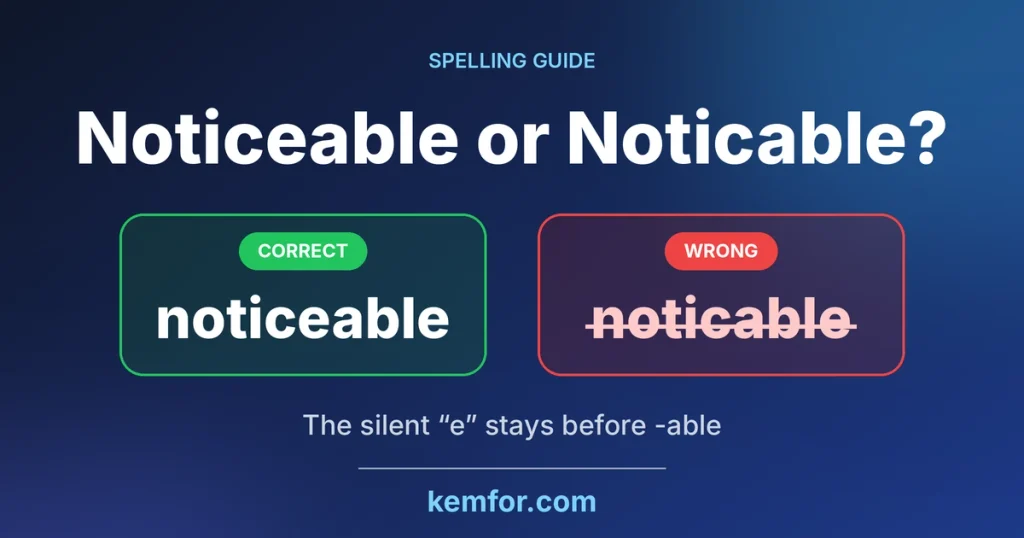
“Noticeable” is the correct spelling. “Noticable” is a common misspelling and is not accepted in standard American or British English. The silent e from the root word “notice” stays in place before the suffix -able.
Correct: The difference in color was barely noticeable. Incorrect: The difference in color was barely noticable.
That’s the whole answer. The rest of this guide explains why, shows you how to use the word, and gives you simple tricks to get it right every time.
What Does “Noticeable” Mean?
Noticeable is an adjective meaning easy to see, hear, or perceive; clear enough to attract attention. It describes something that stands out, whether that’s a visual change, a sound, a smell, or a shift in behavior.
The word is built from two parts:
- Notice: to become aware of something
- -able: a suffix meaning “capable of” or “worthy of”
Put them together and you get “capable of being noticed.” That simple breakdown is also the key to spelling it correctly, because you’re attaching -able to the full word “notice,” and “notice” ends in an e.
Common synonyms for noticeable:
- obvious
- apparent
- visible
- conspicuous
- perceptible
- evident
- striking
- marked
Why “Noticable” Is Wrong: The Silent E Rule
Most spelling guides teach this rule: when you add a suffix beginning with a vowel to a word ending in a silent e, you usually drop the e. That’s why love becomes lovable and use becomes usable. So it’s natural to assume “notice” should become “noticable.”
The catch is that this rule has an important exception, and “noticeable” follows it.
The Soft C and Soft G Exception
When the word ends in -ce or -ge, the final e is doing real work. It tells you that the c or g is “soft,” pronounced like an s or a j. If you drop the e before an a or an o, the letter would switch to its “hard” sound.
Try it with the word itself:
- Noticeable → NO-tiss-uh-bul (soft c, like s)
- Noticable → NO-tik-uh-bul (hard c, like k)
The misspelled version would literally be read aloud with a k sound. Keeping the e protects the pronunciation. That’s the reason behind the spelling, not just a rule to memorize.
Is “Noticable” a Word?
No. “Noticable” does not appear in major dictionaries as an accepted variant. Spell checkers will flag it, and it can make writing look careless in professional settings such as resumes, reports, and marketing copy. If you see it written, it’s a typo or a misspelling, not a regional or alternative spelling.
Other Words That Keep the E Before -able
Once you understand the soft c/g exception, a whole family of words falls into place. These all keep the silent e for the same reason:
- Noticeable (notice + able)
- Manageable (manage + able)
- Changeable (change + able)
- Chargeable (charge + able)
- Enforceable (enforce + able)
- Replaceable (replace + able)
- Traceable (trace + able)
- Serviceable (service + able)
- Peaceable (peace + able)
- Knowledgeable (knowledge + able)
- Pronounceable (pronounce + able)
- Embraceable (embrace + able)
Every one of these would change pronunciation if the e were removed. “Changable,” for example, would force a hard g, like in “gap.”
Words That Drop the E (and Why That Confuses People)
The confusion comes from the many words that do drop the silent e. When the letter before the e isn’t a soft c or g, there’s nothing to protect, and the e usually disappears:
- Usable (use + able)
- Lovable (love + able)
- Desirable (desire + able)
- Believable (believe + able)
- Valuable (value + able)
- Debatable (debate + able)
- Excusable (excuse + able)
A few words, such as likable/likeable, sizable/sizeable, and movable/moveable, accept both spellings. “Noticeable” is not one of them. Only the version with the e is correct.
Why Do So Many People Misspell Noticeable?
There are a few understandable reasons:
- Overapplying the “drop the e” rule. Many of us learned the general rule but not the exception.
- Sound-based spelling. In casual speech, the middle of the word is quick and unstressed, so the e is easy to skip.
- Autocorrect dependence. If your device usually fixes it for you, you never build the habit.
- Visual similarity. “Noticable” looks like many other correct words (lovable, usable), so it passes the quick glance test.
Knowing these causes helps because you can catch yourself in the act. If you notice you’re typing -able after a word that ends in -ce or -ge, pause and check for the e.
How to Use “Noticeable” in a Sentence
Seeing the word in context helps lock in the spelling. Here are examples across different situations:
- Everyday writing: “There was a noticeable chill in the room after the announcement.”
- Business writing: “We saw a noticeable improvement in conversion rate after redesigning the landing page.”
- Academic writing: “The study found a noticeable difference between the two groups.”
- Product reviews: “The battery life upgrade is noticeable from the first day.”
- Personal communication: “I know it’s a small thing, but your effort was really noticeable, and I appreciate it.”
Noticeable vs. Noticeably vs. Unnoticeable
The same spelling rule carries through to the related forms:
- Noticeable (adjective): “a noticeable change”
- Noticeably (adverb): “The weather turned noticeably colder.”
- Unnoticeable (adjective): “The scratch was almost unnoticeable.”
- Noticeability (noun, less common): “The noticeability of the sign improved after we repainted it.”
In each case, the e after the c stays. If you remember that one pattern, you’ve covered the whole word family.
Noticeable vs. Notable: Not the Same Thing
People sometimes swap these words, but they carry different meanings:
- Noticeable means easy to perceive: “a noticeable stain.”
- Notable means worthy of attention or important: “a notable achievement.”
A stain can be noticeable without being notable. A scientist can be notable without being noticeable in a crowd. Choose based on whether you mean “easy to see” or “worth recognizing.”
American vs. British English: Any Difference?
No. Both American and British English use noticeable. Unlike words such as color/colour or organize/organise, there is no regional split here. If you see “noticable” in either variety of English, it’s an error.
Easy Ways to Remember the Correct Spelling
- Think “notice” first. You’re just adding -able to the whole word notice. Don’t cut anything off.
- Use the sound test. Say “noticable” out loud with a hard k sound. If it sounds wrong, the e belongs there.
- Use a mnemonic. “You can’t be noticed without an E to help.” Any silly phrase works if it sticks.
- Group it with similar words. Learn noticeable, manageable, and changeable as a set. They share the same rule.
- Turn on spell check, but don’t rely on it. It will catch “noticable,” but it won’t help when you’re writing by hand or in an app without a checker.
Frequently Asked Questions
Is it noticeable or noticable?
The correct spelling is noticeable. The silent e stays so the c keeps its soft s sound.
Is “noticable” ever correct?
No. “Noticable” is a misspelling in both American and British English. It isn’t listed as an alternative spelling in standard dictionaries.
Why does noticeable keep the e?
Because the word ends in a soft c. Dropping the e before -able would make the c sound like a k. The same principle applies to words like manageable, changeable, and enforceable.
What is the adverb form of noticeable?
The adverb is noticeably, as in “noticeably faster.” Like the adjective, it keeps the e.
What is the opposite of noticeable?
Common opposites include unnoticeable, imperceptible, hidden, subtle, and inconspicuous, depending on the context.
What are some synonyms for noticeable?
Good alternatives include obvious, apparent, visible, conspicuous, perceptible, and striking. Pick the one that best fits your tone and context.
Does the same rule apply to other words ending in -ce or -ge?
Yes. Words like replaceable, traceable, chargeable, and knowledgeable all keep the e before -able to preserve the soft c or g sound.
Final Thoughts: Noticeable or Noticable?
The debate over noticeable or noticable has a clear winner: noticeable, with the e, every time. The rule is simple once you see it. When a word ends in a soft c or g, the silent e stays before -able to protect the sound. Remember that, and you’ll spell manageable, changeable, and enforceable correctly too.
Small spelling slips are easy to make and surprisingly easy to spot. In professional writing, one wrong word can chip away at credibility, even when the rest of your message is strong.