Few words trip up confident writers quite like this one. You type it quickly, the letters feel right, and then a red squiggle appears. Or worse, no squiggle appears because you were writing in a field where nobody checks, and the typo goes out into the world under your name.
The question of believe or beleive is not a matter of regional preference or style. One version is the standard English spelling, and the other is an error. Still, simply being told “it’s believe” rarely sticks. Writers who understand why a spelling is correct remember it far longer than those who only memorize it.
This guide gives you the answer immediately, then goes further: why the mistake is so tempting, how the famous “i before e” rule applies, where the rule breaks, where the word comes from, and which practical habits keep the error out of your writing for good.
The Short Answer: Believe Is Correct
The correct spelling is b-e-l-i-e-v-e. The letter order inside the word is l-i-e-v, with the i before the e.
“Beleive” is a misspelling. It does not exist as a variant in American, British, Canadian, Australian, or any other major standard of English. No dictionary lists it as an alternative form.
Here is the correct word in a few natural settings:
- “I believe the meeting starts at nine.”
- “She couldn’t believe how quickly the year had passed.”
- “Whether you believe it or not, the old bridge is still standing.”
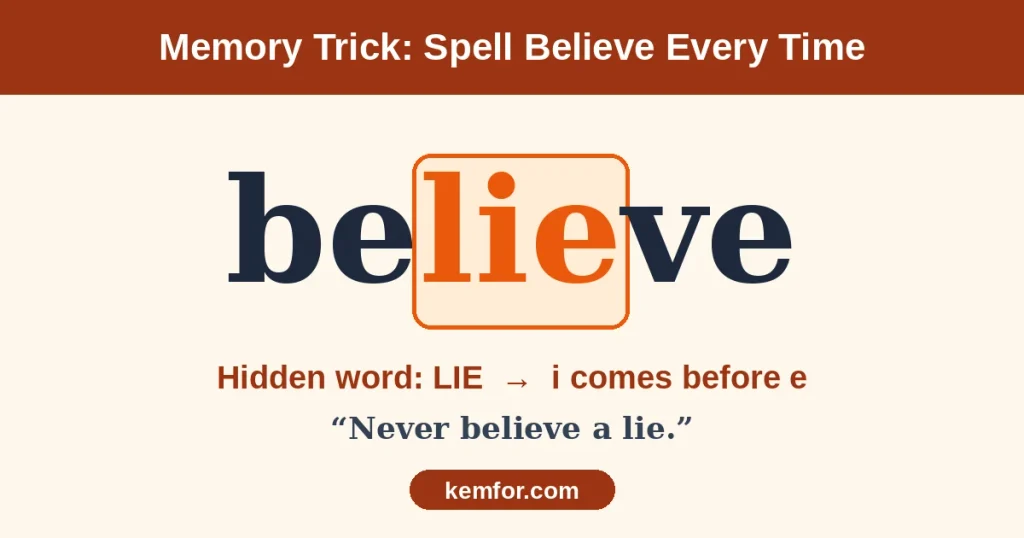
If you remember nothing else from this article, remember that the middle of the word reads “lie,” and the “i” comes first.
Why “Beleive” Looks Right to So Many Writers
Misspellings are rarely random. They usually reveal something about how the brain processes language. The error in “beleive” is one of the most predictable in English, and understanding its cause makes it easier to avoid.
The Sound Trap
English spelling does not map neatly onto pronunciation. In believe, the stressed syllable contains a long “ee” sound, /biˈliːv/. But English spells that same sound in many ways: ee in “need,” ea in “beat,” e-e in “scene,” ie in “field,” ei in “receive.” When you hear the sound, nothing in it tells you which spelling to pick.
Many writers, hearing a long “ee” sound, default to the spelling they have seen most often. For a lot of people, that guess lands on “ei,” because words like receive, ceiling, and neither are common and visually prominent.
The Visual Swap
The second cause is purely mechanical. The letters “i” and “e” sit next to each other in the word, and the brain does not always read letters one by one. Skilled readers recognize whole word shapes, which is why you can read a sentence with scrambled middle letters without much effort. The same skill that makes reading fast makes proofreading your own typos hard. Your eyes see “beleive” and your brain quietly corrects it to “believe” before you consciously notice.
Typing adds a third factor. The “i” and “e” keys are separated on a standard keyboard, but the fingers of two different hands often fire in a different order than intended, especially at speed. This transposition error is extremely common with any pair of adjacent letters that are easy to reverse.
The “I Before E” Rule and Where Believe Fits
Most English speakers learn a rhyme at school: “i before e, except after c, or when sounding like ‘ay’ as in neighbor and weigh.” The rhyme exists specifically to settle spelling questions like the one in this article.
What the Rule Actually Says
Broken into parts, the guidance is:
- Write ie when the sound is a long “ee.”
- Write ei when the letters follow a c.
- Write ei when the sound is a long “ay.”
Believe has the long “ee” sound, and there is no “c” before the vowel pair. Rule one applies directly, so the spelling is “ie.”
Words That Follow the Pattern
Here are common words where the rule works cleanly:
- ie after most consonants: believe, relieve, retrieve, achieve, belief, chief, field, grief, piece, priest, shield, thief, yield, brief, niece
- ei after c: receive, deceive, perceive, conceive, receipt, ceiling, conceit
- ei with an “ay” sound: neighbor, weigh, eight, vein, reign, freight, sleigh
Notice that believe has several close relatives in the first group: relieve, retrieve, and achieve all share the same ending and the same logic. If you can spell one, you can spell all of them.
Exceptions That Confuse Everyone
A fair account of the rule has to admit that it is unreliable. Many linguists and teachers point out that the number of exceptions is large enough that the rhyme is more a rough guide than a law. Knowing the common exceptions prevents overcorrection, where a writer becomes so wary of “ie” that they start writing “ei” everywhere.
Words that break the rule include:
- weird, seize, either, neither, leisure (in some pronunciations), protein, caffeine
- species, science, ancient, efficient, sufficient, society (here “ie” follows a “c,” but the “c” does not make the usual “s” or “k” sound pattern the rule assumes)
- foreign, height, their, heir, forfeit, counterfeit, sovereign
The important lesson is that exceptions do not make believe uncertain. Believe is a regular, fully rule-compliant word. The confusion around it comes from the difficulty of the broader rule, not from anything unusual in the word itself.
If it helps, treat the exceptions as a short list to memorize, and treat everything else with a long “ee” sound as “ie” unless a “c” comes right before.
A Quick Look at the Word’s History
Words carry their past in their spelling, and believe has a long one. It traces back to Old English, where related forms such as gelīefan meant to hold something as true or trustworthy. Linguists connect these forms to older Germanic roots, which also link to the idea of holding something dear or valuing it. The German verb glauben, “to believe,” is a distant relative.
Over centuries, the spelling shifted as Middle English scribes, and later printers, tried to represent the changing sounds of the language. The vowel pair that now sits in the middle of the word settled into its modern “ie” form as spelling became standardized, a process that accelerated with the spread of printing and, later, the publication of major dictionaries.
This history explains why English spelling often looks inconsistent. The letters frequently preserve older pronunciations or the habits of earlier printers rather than the current sound. When a spelling feels illogical, it is usually because it is a fossil of a system that no longer exists.
Memory Tricks That Work for Believe
Rules are useful, but a short memory hook is faster in the middle of a sentence. The best tricks are specific, visual, and slightly memorable.
The “Lie” Trick
The most widely taught aid for this word is the hidden “lie.” Look at the middle of believe: be-LIE-ve. A common teaching line is, “Never believe a lie.” The word literally contains “lie” in the middle, and “lie” is spelled with the “i” before the “e.”
If you ever write “beleive,” the hidden word breaks. You get “bel-e-ive,” which contains nothing recognizable. That visual check takes about one second and catches the error reliably.
Chunking the Word
Another approach is to break the word into three syllable-shaped pieces when you learn it: be · lie · ve. Say them slowly, write them in pieces, and then join them. Chunking works because it forces you to attend to the vowel pair as its own unit instead of a blur in the middle of a longer string.
A few more supports:
- Say it with a deliberate spelling pronunciation: “be-LIE-ve,” even though that is not how it sounds in conversation. Only you hear it, and it helps your memory.
- Write it ten times by hand. Handwriting engages motor memory differently from typing.
- Link it to sister words. Practice believe, relieve, retrieve, achieve together so the pattern reinforces itself.
Believe and Its Word Family
One reason to get this word right is that it anchors a whole family of related words. When you know the base spelling, the family follows with only minor changes.
| Word | Part of Speech | Example |
|---|---|---|
| believe | verb | “I believe you.” |
| belief | noun | “Her belief in fairness shaped her career.” |
| believer | noun | “He was a believer in slow, steady progress.” |
| believable | adjective | “The character felt believable and human.” |
| unbelievable | adjective | “The view from the summit was unbelievable.” |
| disbelieve | verb | “Juries are told not to disbelieve a witness without reason.” |
| disbelief | noun | “She stared in disbelief.” |
| believing | present participle | “Believing in yourself is only the first step.” |
Two details are worth noticing. First, the verb believe ends in -ve, while the noun belief ends in -f. This is a regular English pattern: believe/belief, prove/proof, grieve/grief, relieve/relief. The vowel pair “ie” stays constant, so the spelling problem is the same in every member of the group.
Second, when you add a suffix beginning with a vowel, the silent final “e” of believe drops: believing, not believeing. When the suffix begins with a consonant, as in believer or believable, the “e” stays or is already part of the suffix.
Using Believe Correctly in a Sentence
Spelling is only half of correctness. Knowing how the verb behaves in a sentence makes your writing sound natural and precise.
Believe + That
The most common construction is believe followed by a clause, often with “that” optional:
- “I believe (that) the report is accurate.”
- “Researchers believe the sample was contaminated.”
Using “I believe” at the start of a sentence also works as a softener, signaling that you are offering a view rather than a proven fact. That is a useful habit when you want to sound careful without sounding evasive.
Believe In vs. Believe Someone
These two constructions carry different meanings, and mixing them up changes your message.
- Believe someone or something means you accept it as true or truthful: “I believe her.” “I don’t believe that story.”
- Believe in someone or something means you have trust, confidence, or conviction in its value or existence: “I believe in our team.” “She believes in second chances.”
You can believe a person without believing in them, and the reverse. Saying “I believe him” is about his honesty on a specific point. Saying “I believe in him” is about his potential or character.
Fixed Expressions
English has several set phrases built on this verb, and each one requires the correct spelling:
- Believe it or not — used before a surprising fact
- Make-believe — pretend or imaginary, as in children’s games
- Seeing is believing — a saying about the persuasive power of direct evidence
- Believe you me — an emphatic, informal expression
- Hard to believe — used when something seems surprising
Misspelling a word inside an established phrase tends to stand out even more, because readers expect the idiom to look familiar.
Other Misspellings of Believe
“Beleive” is the leader, but it is not the only way the word gets mangled. Writers who search for the question of believe or beleive often also run into these variants:
- belive — dropping the “e” from the vowel pair entirely
- beleve — dropping the “i” and keeping only “e”
- beleiv — dropping the final “e” in addition to swapping the vowels
- bellieve — doubling the “l” by mistake, probably through association with words like belly or bellow
- believ — leaving off the silent final “e”
Each of these has the same underlying cause: the spelling does not fully reveal the sound, so the writer reconstructs it from partial memory. The “lie” trick works as a check against all of them, because every one of these variants breaks the hidden word.
Why Spelling Believe Correctly Matters in Professional Writing
Some people dismiss spelling errors as trivial, especially in the age of autocorrect. That view underestimates how readers actually respond to text.
Credibility and First Impressions
Readers form judgments quickly. A single misspelling in a headline, a résumé, a cover letter, or a product page can quietly lower the reader’s confidence in everything else on the page. The word believe is especially risky because it appears in motivational copy, brand statements, and opening lines (“We believe…”), which are exactly the places where authority matters most. A typo in “We beleive in quality” undercuts the very claim it makes.
Search and Discoverability
Search engines are generally good at recognizing common misspellings. If a user types “beleive” into a search box, they will usually be shown results for the correct word. That means misspelling a word on your own page does not typically help you rank for the misspelled query, and it can make your content look careless. Treat correct spelling as a basic quality signal rather than a ranking trick. Pages that read as carefully edited tend to earn more trust from the people who land on them, and trust is what keeps readers on a page.
A related point for site owners: if your audience commonly searches for the misspelling, the useful approach is to answer the question honestly, as this article does, rather than to scatter the error through your content.
Habits and Tools to Catch the Error
Knowing the rule is not enough if your own eyes cannot see your own mistakes. The following habits help in practice.
Use a spell checker, but do not depend on it fully. Most word processors flag “beleive” immediately. The danger arises in places where checks are weak: social media captions, text fields in web forms, image-based graphics, slide decks with spell check turned off, and text inside design files.
Read your work in a different format. Changing the font, increasing the zoom, or printing the page forces your eyes to treat the text as new. Many editors read a draft backward, sentence by sentence, to separate their attention from the meaning.
Search your own document for the word. If you know you are prone to this spelling slip, use the find function to search for “beleive,” “belive,” and “beleve” before publishing. It takes seconds.
Add a custom autocorrect entry. Most word processors and phones let you create a shortcut that automatically replaces “beleive” with “believe.” Once set, the error fixes itself every time you make it.
Keep a personal error list. Professional writers often track their own recurring mistakes. Over a few weeks, you will notice patterns, and targeted attention to just five or six words can raise your accuracy noticeably.
Teaching Believe to Children and Language Learners
Spelling instruction works best when it balances rules with repeated, low-pressure practice. For this word, a few approaches stand out.
For children: Use the “lie” hook early, since children enjoy a slightly mischievous mnemonic. Pair it with a writing game: have them circle the hidden word “lie” in believe and then find hidden words in other vocabulary. Short, frequent practice sessions beat a single long drill.
For English learners: Many learners meet the “i before e” rhyme and then discover its exceptions, which can feel discouraging. It helps to frame the rule as a guide to the most common cases and to teach high-frequency words as whole units. Believe is worth treating as a core word, since it appears constantly in everyday speech and writing. Pair it with its family members, and practice the pronunciation of /biˈliːv/ alongside the spelling so that sound and shape reinforce each other.
For adult writers who struggle: Adults are often embarrassed by spelling errors, but persistent trouble with a few words is normal and does not reflect intelligence. Writers with dyslexia, in particular, may find letter-order errors more frequent, and assistive tools such as text-to-speech or specialized spell checkers can be genuinely helpful.
A Short Practice Exercise
Test yourself. Choose the correct spelling in each sentence, then check the answers below.
- “I can hardly (believe / beleive) it’s already November.”
- “The children enjoyed a game of make-(believe / beleive).”
- “She stared at the results in (disbelief / disbeleif).”
- “He is a firm (believer / beleiver) in daily practice.”
- “It was an (unbelievable / unbeleivable) performance.”
- “It took weeks to (receive / recieve) the package.”
Answers: 1. believe; 2. believe; 3. disbelief; 4. believer; 5. unbelievable; 6. receive.
If you missed number six, it is a useful reminder of the “except after c” part of the rule, which is the other half of the same puzzle.
Conclusion
The answer to believe or beleive is simple: believe is the only correct spelling, and “beleive” is a common error with an understandable cause. The long “ee” sound does not signal its own spelling, the “i” and “e” are easy to swap, and the well-known rhyme about “i before e” is both helpful and unreliable.
What makes the difference is a small toolkit. Remember the hidden “lie” in the middle of the word. Link believe to relieve, retrieve, and achieve. Treat the exceptions as a short list rather than a reason for doubt. Run a quick search for the usual typos before you publish anything important. These habits take almost no time, and they protect something valuable: the reader’s confidence that you know what you are doing.
Spelling is never the most exciting part of writing, but it is one of the clearest signs of care. Get this one word right, and a small but persistent source of embarrassment disappears.
Frequently Asked Questions
Is it “believe” or “beleive”?
The correct spelling is believe. The “i” comes before the “e.” “Beleive” is a misspelling and is not accepted in any standard dictionary or variety of English.
What is the easiest way to remember how to spell believe?
Look for the word “lie” in the middle: believe. A common memory line is “Never believe a lie.” If the hidden word is not there, the spelling is wrong.
Why do people so often write “beleive”?
There are two main reasons. The long “ee” sound can be spelled several ways in English, so listening does not reveal the right one. Also, the “i” and “e” sit side by side, and both reading and typing can easily swap them without the writer noticing.
Does the “i before e except after c” rule explain believe?
Yes. In believe, the vowel pair makes a long “ee” sound and does not follow the letter “c,” so the rule calls for “ie.” The same logic applies to relieve, retrieve, achieve, and belief.
Are there words where this rule does not work?
Yes, quite a few. Common exceptions include weird, seize, either, neither, protein, caffeine, and species. These must be learned individually. The existence of exceptions does not affect believe, which follows the regular pattern.
Is “belief” spelled the same way as “believe”?
The vowel pair is the same, but the ending differs. The verb is believe, ending in “-ve,” and the noun is belief, ending in “-f.” Both use “ie” in the middle.
Will a spelling mistake like “beleive” hurt my website’s search ranking?
Search engines generally recognize common misspellings and surface results for the correct word, so one typo is unlikely to cause a dramatic drop on its own. However, errors can lower reader trust and make content look less carefully edited, which can affect how people engage with your page. Correct spelling is a simple, worthwhile quality standard.
Is there a British versus American difference in how believe is spelled?
No. Both spell it believe. Unlike words such as color/colour or organize/organise, this word has no regional variant.